Reedville
Mariners' Museum, Uncurated Search Results
Type: Ram
Year: 1910
Builder: E. J. Tull
Location: Pocomoke City
These records are found in the online catalog of The Mariners’ Museum and Park in Newport News, Virginia. Uncurated search results are presented to give researchers and interested readers an idea of whether the museum’s archives contain information about this vessel and whether it may be worthwhile to visit the museum’s catalog search page for further investigation. Uncurated results may be inaccurate or incomplete.
Search mode: Exact Name. Search phrase(s): "Reedville". Results returned: 91. Results displayed in this table: 91.
Use these buttons to send uncurated search results to your own app or text document for further research. First, check the box for any row, or click "Select All" then uncheck any rows. Then click "Show Selections". You can then copy your selections from the text box and past them into your app.
| Fetch? | Row ID | Media | Date | Vessel | Place | Related Places | Inscription/Marks | Subject | Notes | Archive Number |
|---|---|---|---|---|---|---|---|---|---|---|
| 1 | No image URL. | Reedville (Va.)–Description and travel. | Destination Reedville | LB104154 | ||||||
| 2 | No image URL. | Reedville (Va.)–History | Reedville, 1874-1974 __ __[Miriam Haynie] | LB26349 | ||||||
| 3 | No image URL. | Reedville | P0001.011/01-2548 | |||||||
| 4 | No image URL. | Reedville, Virginia | P0001.008/01-543 | |||||||
| 5 | No image URL. | Reedville Fishermen's Museum (Reedville, Va.). | Reedville (Va.). | Reedville Fisherman's Museum and the Skipjack Cloude W. Somers. | LB90780 | |||||
| 6 | 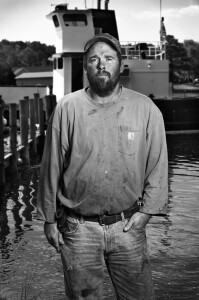 | 2010 | Chesapeake Bay (Md. and Va.) | Danny Balderson, 38, is the engineer and pilot of the Hush Puppy, a snapper rig that’s usually moored at Ray Rogers’ dock. Danny has been working the water for 18 years and comes from a long line of Reedville watermen. | MS0568/-#52 | |||||
| 7 | 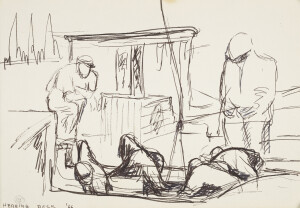 | SHORT DESCRIPTION: Drawing, pen and ink. Sketch is part of a group that documents the pound fishing in the Chesapeake Bay. This sketch is the tenth in the series and documents "The catch is brought to the fish dock at Reedville, Va." NOTES: 1982.25.01 to 1982.25.31 illustrate the activities related to pound fishing in the Chesapeake Bay region. There is a document in the file that identifies each of the images and the particular activity the image documents. The text of the document states: Pound fishing. Pound nets or fish traps are fished spring and fall. An extensive herring fishery has declined during the past twenty years, partly because of offshore foreign fishing. At one time herring was a mainstay of the waterman’s winter diet, but any that is caught now goes into pet food, with a few being shipped off for pickling. Grey trout, striped bass, and blues are taken for wholesale and retail marketing. 1) The pound boat leaves its dock at dawn, timed for low tide at the nets. (1982.25.1); 2) Nets are hung on pine poles 25 to 70 feet long, and sway with wind, waves, and weight of the net. (1982.25.2); 3) Crewmen leave the pound boat in their skill to enter pound, a square at the end of a long leader extending shoreward. (1982.25.3); 4) Beginning to pull the seine. (1982.25.4); 5) Seine is pulled into a tight pocket. (1982.25.5); 6) Seine is close to the pound boat which has been anchored to a stake. (1982.25.6); 7) Aboard the pound boat, man operates a dip net, bringing fish to the hold of the pound boat. (1982.25.7); 8) Net is re-set on stakes for another catch. (1982.25.8); 9) Captain Walter Biddlecomb, 9 1973, who fished several deep water pounds off the mouth of the great Wicomico River. In earlier years he was a menhaden captain. (1982.25.9); 10) The catch is brought to the fish dock at Reedville, Va. (1982.25.10); 11) Sorting food and bait fish. (1982.25.11); 12) A casual buyer. (1982.25.12); 13) Fish is canned immediately. This was at the Harryhogan, Va. Cannery on the Yeocomico river, 1966, now closed. (1982.25.13); Another Day, Another Boat 14) Odell Fitchett, Palmer, Virginia (1982.25.14); 15) Pound net is loosened (1982.25.15); 16) Catch is pulled close to the pound boat (1982.25.16); 17) Title missing (1982.25.17); 18) More pulling (1982.25.18); 19) Dip net raises the fish (1982.25.19); 20) Pulling the dip net aboard pound boat (1982.25.20); 21) The last fish are dipped from the pound (1982.25.21); 22) Fitchett looking at slashes made in net by bluefish (1982.25.22); 23) He points (1982.25.23); 24) Net mending (1982.25.24); 25) Net mending (1982.25.25); 26) Net mending (1982.25.26); 27) Net mending, the blues took a considerable bit of the catch this time (1982.25.27); 28) Retying the pound (1982.25 28); 29) Unloading at the dock. (1982.25.29); 30) Lunch (1982.25.30); 31) Stern of the Jenny Dare, Fitchett boat (1982.25.31); | CL13060 | |||||||
| 8 | 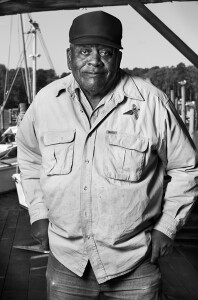 | 2010 | Chesapeake Bay (Md. and Va.) | Raleigh Nutt, Jr.,76, grew up near Ditchley, Virginia and moved to Reedville in 1955. Asked about his family, Raleigh says his father, Raleigh Nutt Sr., was a fisherman, and his one son is also in a related industry. Raleigh has worked on the water since he was 16 years old. He is now a crab potter with 170 crab pots in the Chesapeake Bay and Great Wicomico River. He tends them using his 38' box-stern boat. He says there are plenty of crabs these days, but the price is not very good. | MS0568/-#20 | |||||
| 9 | 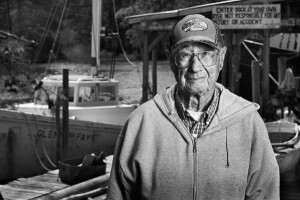 | 2010 | Chesapeake Bay (Md. and Va.) | Ray Rogers, Jr. has two sons and two sons-in-law in the fishing business. Even his daughter worked awhile for her uncle when Ray refused to hire her. He operates out of a shady waterside property with a big dock for the boats and a huge military-surplus Quonset hut, part of the property he bought after World War II. He works with his two sons purse seining for menhaden and pound netting. | MS0568/-#21 | |||||
| 10 | 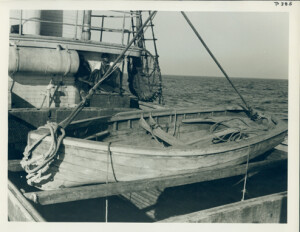 | 1984 | USA; VIRGINIA; REEDVILLE | CURATOR NOTES: Close view of boat tied on deck of fishing boat. | P0001.001/01-#P385 | |||||
| 11 | 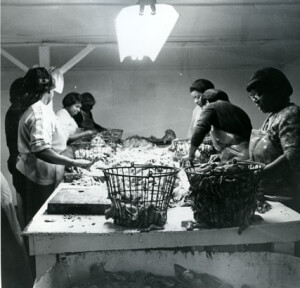 | 1964 | USA; VIRGINIA; REEDVILLE | WRITTEN ON VERSO: WOMEN WORKERS HEAD, GUT, AND CUT HERRING AT REEDVILLE, OIL & GUANO PACKING HOUSE, REEDVILLE, VA 1964 | WOMEN WORKERS IN FISH PROCESSING HOUSE | P0001.001/01-#P4033 | ||||
| 12 | 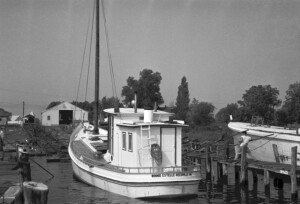 | USA; VIRGINIA; REEDVILLE | WRITTEN ON VERSO: POUND BOAT WINNIE ESTELLE | CURATOR NOTES: Two boatyard workers guiding the WINNIE ESTELLE , REEDVILLE,VA. into place on railway | P0001.001/01-#P5648 | |||||
| 13 | 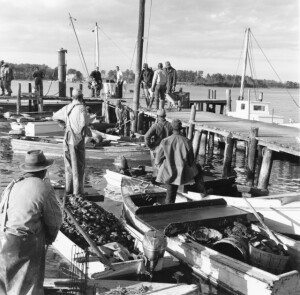 | WRITTEN ON VERS0: TONGERS RETURNING TO SUNNYBANK DOCK. | Oystering–Chesapeake Bay (Md. and Va.).; African Americans. | View looking over several small fishing boats and men with their day's catch toward the pier at Sunny Bank dock, Reedville, Va. | P0001.001/01-#P4026 | |||||
| 14 | 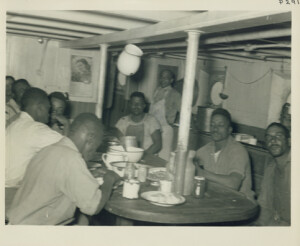 | 1947 | VIRGINIA; REEDVILLE | CURATOR NOTES: Interior view of African-American cook and crew posed in galley. Photograph is a little soft | P0001.001/01-#P291 | |||||
| 15 | No image URL. | Menhaden Products Company, Inc; Lancaster Land Corporation | Fish oil industry–Virginia.; Fisheries–Chesapeake Bay (Md. and Va.).; Menhaden fisheries–Virginia. | The collection contains various papers relating to the company including correspondence from German companies, Procter & Gamble Company, and the Virginia Fishermens Association, Reedville, and some concerning fish oil prices; bills from other companies for supplies used by Menhaden Products; and a 1931 indenture of F. M. Armstrong of Kilmarnock, Va., with the Lancaster Land Corporation. | MS0027 | |||||
| 16 | 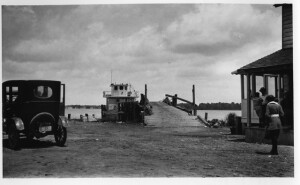 | USA; VIRGINIA | WRITTEN ON VERSO: FERRY AT MCGUIRES WHARF, VIRGINIA, E.T. SOMERS MOTOR FERRY | Ferry seen docked alongside ramp. Model T automobile parked in foreground. View of vessel at McGuire's Wharf, VA | P0001.010/01-#PJ329 | |||||
| 17 | 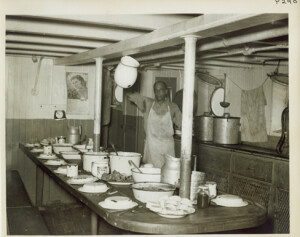 | 1947 | VIRGINIA; REEDVILLE | CURATOR NOTES: Interior view of standing African-American cook posed in galley. | P0001.001/01-#P290 | |||||
| 18 | No image URL. | VESSEL INFORMATION - VESSEL NAME: H.R. HUMPHREYS VESSEL BUILT: 1919 SHIP BUILDER: HUMPHREYS MARINE RAILWAY, INC. BUILDER LOCATION: WEEMS, VIRGINIA VESSEL DIMENSIONS: 211 gross tons, 126.1 x 20.7 x 9.7 REGISTERED: REEDVILLE, VIRGINIA SHIP OWNER: BELLOWS & SQUIRES CO. 1925 VESSEL HISTORY: Sunk off Ocean City, Maryland. | CL4191 | |||||||
| 19 | No image URL. | Archival collection relating to Thomas William Haynie of Reedville, Virginia. Included in the collection are bills of lading and sale, receipts, etc. from ship chandlers and others supplying Haynie and his boats. Also included are receipts for licenses for oyster grounds, tax receipts and more. | MS0643 | |||||||
| 20 | 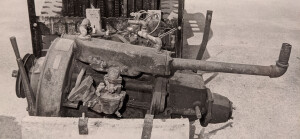 | NOTES: Four cylinder Lathrop LH-4 marine gas engine used on pound boat, FRED at Reedville, Va. from mid 1940s to mid 1960s. TIME-SPACE: 1920-1965 | CL21678 | |||||||
| 21 | 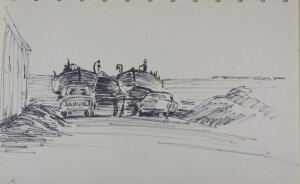 | SHORT DESCRIPTION: Drawing, pen and ink. Sketch is part of a group that documents the Chesapeake Bay Menhaden Fishery. This sketch is the fifteenth in the series and documents "Two purse boats on shore at a Reedville fish factory. Purse boats, once built of cedar on oak frames, now are all aluminum." NOTES: 1982.25.51 to 1982.25.67 illustrate the daily activities related to the menhaden fishery. There is a document in the file that identifies each of the images and the particular activity the image documents. The text of the document states: THE CHESAPEAKE BAY MENHADEN FISHERY, Menhaden fishboats, or pogy boats, sail between midnight and dawn, to be fishing as soon as the sun is up and spotter planes lead them to schools of bunkers. 1) The days first set. Purse boats have been sent out from the fishboat to surround a school (1982.25.51); 2) The men (captain's purse boat is at right, mate's at left) begin to draw up the seine on raised power blocks, which do the work once done by up to 40 men. (1982.25.52); 3) Purse boat to the right lists from the weight of seine and fish. (1982.25.54); 4) Fish are jumping inside the pursed seine. (1982.25.55); 5) Most of the purse seine has been drawn up and stowed in the purse boats. (1982.25.56); 6) Purse boats await the approach of the fishboat. (1982.25.57); 7) Fishboat comes alongside the seine and purse boats. (1982.25.58); 8) Purse boats form a triangle against the fishboat side. Net is raised on fishboat gaff and pump hose is lowered into mass of fish. (1982.25.59); 9) The men heave on the seine as the pump empties the pocket. (1982.25.60); 10) The emptied net is hauled aboard the purseboats. (1982.25.61); 11) These men work together as they have for years. (1982.25.62); 12) Same men. (1982.25.63); 13) The seine must be ready for the next set. (1982.25.64); 14) A winter chore, in a field ashore. (1982.25.65) 15) Two purse boats on shore at a Reedville fish factory. Purse boats, once built of cedar on oak frames, now are all aluminum. (1982.25.66); 16) Pogy boats tied up off-season at Weems shipyard, 1963. (1982.25.67) There is an untitled duplicate of sketch number 3 that is not accounted for. (1982.25.53); | CL13012 | |||||||
| 22 | No image URL. | VESSEL INFORMATION - VESSEL NAME: THOMAS C. MCNEAL VESSEL BUILTAa: 1923 SHIPBUILDER: M.M. DAVIS & SONS BUILDER LOCATION: SOLOMONS ISLAND, MARYLAND VESSEL DIMENSIONS: 219 gross tons, 117 net tons, 127.9 x 21.1 x 9.8 REGISTERED: REEDVILLE, VIRGINIA SHIP OWNERS: MCNEAL EDWARDS CO. 1925 | CL4198 | |||||||
| 23 | No image URL. | VESSEL INFORMATION - VESSEL NAME: WILLIAM BLUNDON VESSEL BUILT: 1909 SHIPBUILDERS: M.M. DAVIS & SONS BUILDER LOCATION: SOLOMONS, MARYLAND VESSEL DIMENSIONS: 240 tons gross, 129 tons net, 122.4 x 22.8 x 10.4 SHIP OWNERS: SEABOARD OIL & GUANO CO. (1925) REGISTERED: REEDVILLE, VIRGINIA | CL4189 | |||||||
| 24 | No image URL. | SHORT DESCRIPTION: Single sheave bronze snatch block used on tom weight in Menhaden fishery. One side dented and cracked. Retains original swivel, but shackel missing. NOTES: Hooked onto side loop on tom weight, guiding purse seine line from bottom of net up to power takeup on seine boat. | CL24529 | |||||||
| 25 | 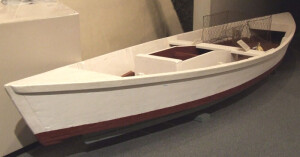 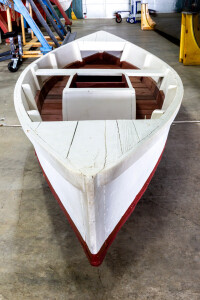 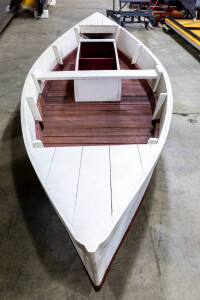 | SHORT DESCRIPTION: Soft crabbing skiff attributed to Charlie Mothershead of Reedville, Virginia, circa 1940. Flat bottomed, double-ended with built-in divided live well at the center with the holes crossed with a nail to prevent eels from entering the live well. Constructed of Loblolly pine with cross-planked bottom and carvel planked sides. | CL21620 | |||||||
| 26 | No image URL. | VESSEL INFORMATION - VESSEL NAME: LITTLE JOE VESSEL BUILT: 1922 SHIP BUILDER: HUMPHREYS MARINE RAILWAY, INC BUILDER LOCATION: WEEMS, VIRGINIA VESSEL DIMENSIONS: 250 gross tons, 134.3 x 21.7 x 10.9 REGISTERED: REEDVILLE, VIRGINIA SHIP OWNERS: BELLOWS & SQUIRES CO. 1925 VESSEL HISTORY: SUNK OFF OCEAN CITY, MARYLAND, 1968 | CL4190 | |||||||
| 27 | No image URL. | VESSEL INFORMATION: VESSEL NAME: VIRGINIA VESSEL BUILT: 1893 BUILDER LOCATION: BORDENTOWN, NEW JERSEY VESSEL DIMENSIONS: 155 tons gross, 42 tons net, 116.1 x 19.6 x 10.7 REGISTERED: REEDVILLE, VIRGINIA SHIP OWNERS: MENHADEN CO. (1942) | CL4193 | |||||||
| 28 | No image URL. | SHORT DESCRIPTION: Double sheave snatch block, all bronze construction from tom crane of a purse seine boat. Heavy patination overall, minor corrosion evident. NOTES: Used to haul in purse line. ADDITIONAL INFORMATION: See J. Frye, "The Men All Singing"; G. Brown Goode, "The Story of The Menhaden". | CL24528 | |||||||
| 29 | No image URL. | SHORT DESCRIPTION: Four sections (full depth) of a 20-fathom purse seine. Cork floats are on separate line. Bottom edge line has small lead weights spaced along to help keep seine in position. Various old repairs evident. | CL21689 | |||||||
| 30 | No image URL. | SHORT DESCRIPTION: Bronze snatch block used on tom crane on menhaden purse seine boats. All bronze with steel cable. some corrosion near hub, havily patinated overall. Missing shackel and swivel. NOTES: Used to haul in purse line. ADDITIONAL INFORMATION: See J. Frye, "The Men All Singing"; G. Brown Goode, "The Story of The Menhaden". | CL23612 | |||||||
| 31 | 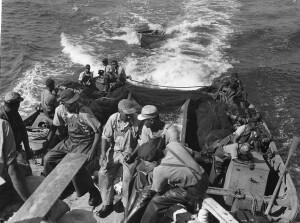 | 1947 | USA; VIRGINIA | WRITTEN ON VERSO: Towing purse boats and dry boat behind MARGARET menhaden fishing vessel of Reedville, Virgina | PURSE BOAT | P0001.001/01-#P293 | ||||
| 32 | No image URL. | SHORT DESCRIPTION: Single sheave snatch block, bronze with steel axle, used on top weight in menhaden fishing. Piece retains original swivel and shackel. Heavily patinated overall with some rust near axle. NOTES: Hooked onto side loop on tom weight, guiding purse seine line from bottom of net up to power takeup on seine boat. ADDITIONAL INFORMATION: See J. Frye, "The Men All Singing"; G. Brown Goode, "The Story of The Menhaden". | CL24530 | |||||||
| 33 | 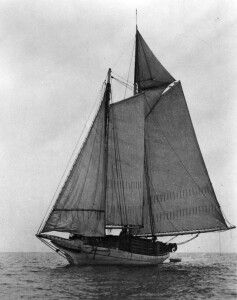 | Amanda F. Lewis. Reedville, Va, Built 1884, of Madison, Maryland. by G.T. Rice. 47T. 67 x 22.3 x 6.5 | From the Percy Budlong Album, 1925-Vol.37. page 68, view of pungy entering Annapolis Harbor, August 1925 | P0001.011/01-#PK7149 | ||||||
| 34 | No image URL. | United States. Navy–Officers–Correspondence.; United States. Navy–Pay, allowances, etc.; Kenneth L. McNeal (Section patrol : S.P. 333).; Finland (Screw schooner : 1902).; Alcedo (Section patrol : S.P. 166).; P. K. Bauman (Section patrol : S.P. 377).; Otis W. Douglas (Section patrol : S.P. 313).; B. H. B. Hubbard, Jr. (Section patrol : S.P. 416).; Long Beach (Cargo ship : I.D. 2136). | World War, 1914-1918–Personal narratives, American.; World War, 1914-1918–Naval operations, American.; Sailors–United States–Correspondence. | The collection consists primarily of letters that Robert Loder sent to his wife, Edna, during his service with the United States Navy. The letters begin when he is stationed at the Norfolk Navy Yard, preparing a minesweeper for overseas duty. The majority of the letters were written while Loder was in France, at both Brest and Lorient. In the letters he describes the general work that he is engaged in. Ever mindful of the military censors, he constantly provides hints so that his family can know where exactly he is stationed or has travelled. Many of the early letters chronicle his attempts to set up a monthly allotment for the support of his family. He also makes frequent references to the war’s progress and some of the destruction that he witnessed. In some of the later letters, Loder mentions how much he wishes the war was over so that he could be home with his family again. The collection also includes six letters or postcards written by people other than Loder. | MS0065 | |||||
| 35 | 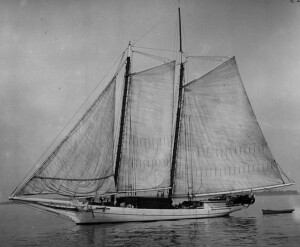 | Circa 1939 | Amanda F. Lewis. Reedville, Va, Built 1884, of Madison, Maryland. by G.T. Rice. 47T. 67 x 22.3 x 6.5 | Pungy Amanda F. Lewis becalmed near Thomas Point Lighthouse, Chesapeake Bay, circa 1939 | P0001.011/01-#PK2601 | |||||
| 36 | 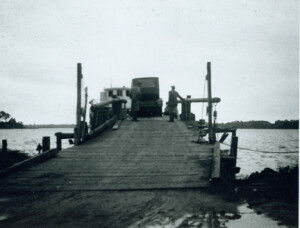 | 1920 | USA; VIRGINIA | WRITTEN ON VERSO: E.T. SOMERS MOTOR FERRY, REEDVILLE, VA. BUILT 1919 AT WHITE HAVEN, MD. | Automobile seen on top of ramp waiting for ferry. View of vessel at Nomini, VA | P0001.010/01-#PJ330 | ||||
| 37 | 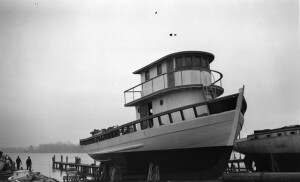 | Amanda F. Lewis. Reedville, Va, Built 1884, of Madison, Maryland. by G.T. Rice. 47T. 67 x 22.3 x 6.5 | Amanda F Lewis being converted to a power boat at Krentz Shipyard, Harryhogan, Va. 1939 | P0001.011/01-#PK7063 | ||||||
| 38 | 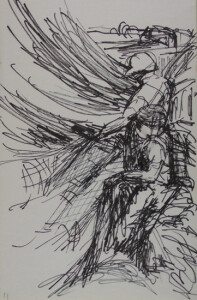 | SHORT DESCRIPTION: Drawing, pen and ink. Sketch is part of a group that documents the Chesapeake Bay Menhaden Fishery. This sketch is the eleventh in the series and documents "These men work together as they have for years. " NOTES: 1982.25.51 to 1982.25.67 illustrate the daily activities related to the menhaden fishery. There is a document in the file that identifies each of the images and the particular activity the image documents. The text of the document states: THE CHESAPEAKE BAY MENHADEN FISHERY, Menhaden fishboats, or pogy boats, sail between midnight and dawn, to be fishing as soon as the sun is up and spotter planes lead them to schools of bunkers. 1) The days first set. Purse boats have been sent out from the fishboat to surround a school (1982.25.51); 2) The men (captain's purse boat is at right, mate's at left) begin to draw up the seine on raised power blocks, which do the work once done by up to 40 men. (1982.25.52); 3) Purse boat to the right lists from the weight of seine and fish. (1982.25.54); 4) Fish are jumping inside the pursed seine. (1982.25.55); 5) Most of the purse seine has been drawn up and stowed in the purse boats. (1982.25.56); 6) Purse boats await the approach of the fishboat. (1982.25.57); 7) Fishboat comes alongside the seine and purse boats. (1982.25.58); 8) Purse boats form a triangle against the fishboat side. Net is raised on fishboat gaff and pump hose is lowered into mass of fish. (1982.25.59); 9) The men heave on the seine as the pump empties the pocket. (1982.25.60); 10) The emptied net is hauled aboard the purseboats. (1982.25.61); 11) These men work together as they have for years. (1982.25.62); 12) Same men. (1982.25.63); 13) The seine must be ready for the next set. (1982.25.64); 14) A winter chore, in a field ashore. (1982.25.65) 15) Two purse boats on shore at a Reedville fish factory. Purse boats, once built of cedar on oak frames, now are all aluminum. (1982.25.66); 16) Pogy boats tied up off-season at Weems shipyard, 1963. (1982.25.67) There is an untitled duplicate of sketch number 3 that is not accounted for. (1982.25.53); | CL13008 | |||||||
| 39 | 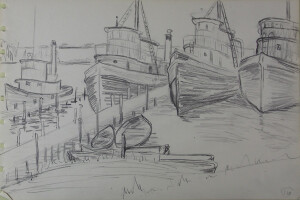 | SHORT DESCRIPTION: Drawing, pencil. Sketch is part of a group that documents the Chesapeake Bay Menhaden Fishery. This sketch is the sixteenth in the series and documents "Pogy boats tied up off-season at Weems shipyard, 1963. " NOTES: 1982.25.51 to 1982.25.67 illustrate the daily activities related to the menhaden fishery. There is a document in the file that identifies each of the images and the particular activity the image documents. The text of the document states: THE CHESAPEAKE BAY MENHADEN FISHERY, Menhaden fishboats, or pogy boats, sail between midnight and dawn, to be fishing as soon as the sun is up and spotter planes lead them to schools of bunkers. 1) The days first set. Purse boats have been sent out from the fishboat to surround a school (1982.25.51); 2) The men (captain's purse boat is at right, mate's at left) begin to draw up the seine on raised power blocks, which do the work once done by up to 40 men. (1982.25.52); 3) Purse boat to the right lists from the weight of seine and fish. (1982.25.54); 4) Fish are jumping inside the pursed seine. (1982.25.55); 5) Most of the purse seine has been drawn up and stowed in the purse boats. (1982.25.56); 6) Purse boats await the approach of the fishboat. (1982.25.57); 7) Fishboat comes alongside the seine and purse boats. (1982.25.58); 8) Purse boats form a triangle against the fishboat side. Net is raised on fishboat gaff and pump hose is lowered into mass of fish. (1982.25.59); 9) The men heave on the seine as the pump empties the pocket. (1982.25.60); 10) The emptied net is hauled aboard the purseboats. (1982.25.61); 11) These men work together as they have for years. (1982.25.62); 12) Same men. (1982.25.63); 13) The seine must be ready for the next set. (1982.25.64); 14) A winter chore, in a field ashore. (1982.25.65) 15) Two purse boats on shore at a Reedville fish factory. Purse boats, once built of cedar on oak frames, now are all aluminum. (1982.25.66); 16) Pogy boats tied up off-season at Weems shipyard, 1963. (1982.25.67) There is an untitled duplicate of sketch number 3 that is not accounted for. (1982.25.53); | CL13013 | |||||||
| 40 | 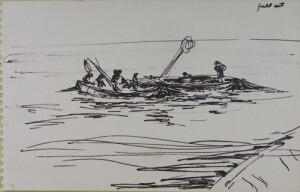 | SHORT DESCRIPTION: Drawing, pen and ink. Sketch is part of a group that documents the Chesapeake Bay Menhaden Fishery. This sketch is the seventh in the series and documents "Fishboat comes alongside the seine and purse boats." NOTES: 1982.25.51 to 1982.25.67 illustrate the daily activities related to the menhaden fishery. There is a document in the file that identifies each of the images and the particular activity the image documents. The text of the document states: THE CHESAPEAKE BAY MENHADEN FISHERY, Menhaden fishboats, or pogy boats, sail between midnight and dawn, to be fishing as soon as the sun is up and spotter planes lead them to schools of bunkers. 1) The days first set. Purse boats have been sent out from the fishboat to surround a school (1982.25.51); 2) The men (captain's purse boat is at right, mate's at left) begin to draw up the seine on raised power blocks, which do the work once done by up to 40 men. (1982.25.52); 3) Purse boat to the right lists from the weight of seine and fish. (1982.25.54); 4) Fish are jumping inside the pursed seine. (1982.25.55); 5) Most of the purse seine has been drawn up and stowed in the purse boats. (1982.25.56); 6) Purse boats await the approach of the fishboat. (1982.25.57); 7) Fishboat comes alongside the seine and purse boats. (1982.25.58); 8) Purse boats form a triangle against the fishboat side. Net is raised on fishboat gaff and pump hose is lowered into mass of fish. (1982.25.59); 9) The men heave on the seine as the pump empties the pocket. (1982.25.60); 10) The emptied net is hauled aboard the purseboats. (1982.25.61); 11) These men work together as they have for years. (1982.25.62); 12) Same men. (1982.25.63); 13) The seine must be ready for the next set. (1982.25.64); 14) A winter chore, in a field ashore. (1982.25.65) 15) Two purse boats on shore at a Reedville fish factory. Purse boats, once built of cedar on oak frames, now are all aluminum. (1982.25.66); 16) Pogy boats tied up off-season at Weems shipyard, 1963. (1982.25.67) There is an untitled duplicate of sketch number 3 that is not accounted for. (1982.25.53); | CL13004 | |||||||
| 41 | 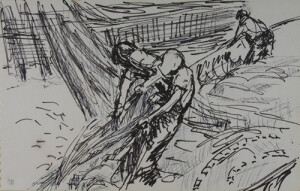 | SHORT DESCRIPTION: Drawing, pen and ink. Sketch is part of a group that documents the Chesapeake Bay Menhaden Fishery. This sketch is the tenth in the series and documents "The emptied net is hauled aboard the purseboats. " NOTES: 1982.25.51 to 1982.25.67 illustrate the daily activities related to the menhaden fishery. There is a document in the file that identifies each of the images and the particular activity the image documents. The text of the document states: THE CHESAPEAKE BAY MENHADEN FISHERY, Menhaden fishboats, or pogy boats, sail between midnight and dawn, to be fishing as soon as the sun is up and spotter planes lead them to schools of bunkers. 1) The days first set. Purse boats have been sent out from the fishboat to surround a school (1982.25.51); 2) The men (captain's purse boat is at right, mate's at left) begin to draw up the seine on raised power blocks, which do the work once done by up to 40 men. (1982.25.52); 3) Purse boat to the right lists from the weight of seine and fish. (1982.25.54); 4) Fish are jumping inside the pursed seine. (1982.25.55); 5) Most of the purse seine has been drawn up and stowed in the purse boats. (1982.25.56); 6) Purse boats await the approach of the fishboat. (1982.25.57); 7) Fishboat comes alongside the seine and purse boats. (1982.25.58); 8) Purse boats form a triangle against the fishboat side. Net is raised on fishboat gaff and pump hose is lowered into mass of fish. (1982.25.59); 9) The men heave on the seine as the pump empties the pocket. (1982.25.60); 10) The emptied net is hauled aboard the purseboats. (1982.25.61); 11) These men work together as they have for years. (1982.25.62); 12) Same men. (1982.25.63); 13) The seine must be ready for the next set. (1982.25.64); 14) A winter chore, in a field ashore. (1982.25.65) 15) Two purse boats on shore at a Reedville fish factory. Purse boats, once built of cedar on oak frames, now are all aluminum. (1982.25.66); 16) Pogy boats tied up off-season at Weems shipyard, 1963. (1982.25.67) There is an untitled duplicate of sketch number 3 that is not accounted for. (1982.25.53); | CL13007 | |||||||
| 42 | 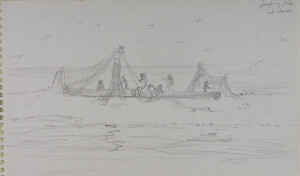 | SHORT DESCRIPTION: Drawing, pencil. Sketch is part of a group that documents the Chesapeake Bay Menhaden Fishery. This sketch is the fourth in the series and documents "Fish are jumping inside the pursed seine." NOTES: 1982.25.51 to 1982.25.67 illustrate the daily activities related to the menhaden fishery. There is a document in the file that identifies each of the images and the particular activity the image documents. The text of the document states: THE CHESAPEAKE BAY MENHADEN FISHERY, Menhaden fishboats, or pogy boats, sail between midnight and dawn, to be fishing as soon as the sun is up and spotter planes lead them to schools of bunkers. 1) The days first set. Purse boats have been sent out from the fishboat to surround a school (1982.25.51); 2) The men (captain's purse boat is at right, mate's at left) begin to draw up the seine on raised power blocks, which do the work once done by up to 40 men. (1982.25.52); 3) Purse boat to the right lists from the weight of seine and fish. (1982.25.54); 4) Fish are jumping inside the pursed seine. (1982.25.55); 5) Most of the purse seine has been drawn up and stowed in the purse boats. (1982.25.56); 6) Purse boats await the approach of the fishboat. (1982.25.57); 7) Fishboat comes alongside the seine and purse boats. (1982.25.58); 8) Purse boats form a triangle against the fishboat side. Net is raised on fishboat gaff and pump hose is lowered into mass of fish. (1982.25.59); 9) The men heave on the seine as the pump empties the pocket. (1982.25.60); 10) The emptied net is hauled aboard the purseboats. (1982.25.61); 11) These men work together as they have for years. (1982.25.62); 12) Same men. (1982.25.63); 13) The seine must be ready for the next set. (1982.25.64); 14) A winter chore, in a field ashore. (1982.25.65) 15) Two purse boats on shore at a Reedville fish factory. Purse boats, once built of cedar on oak frames, now are all aluminum. (1982.25.66); 16) Pogy boats tied up off-season at Weems shipyard, 1963. (1982.25.67) There is an untitled duplicate of sketch number 3 that is not accounted for. (1982.25.53); | CL13027 | |||||||
| 43 | 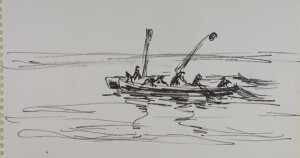 | SHORT DESCRIPTION: Drawing, pen and ink. Sketch is part of a group that documents the Chesapeake Bay Menhaden Fishery. This sketch is the fifth in the series and documents "Most of the purse seine has been drawn up and stowed in the purse boats. " NOTES: 1982.25.51 to 1982.25.67 illustrate the daily activities related to the menhaden fishery. There is a document in the file that identifies each of the images and the particular activity the image documents. The text of the document states: THE CHESAPEAKE BAY MENHADEN FISHERY, Menhaden fishboats, or pogy boats, sail between midnight and dawn, to be fishing as soon as the sun is up and spotter planes lead them to schools of bunkers. 1) The days first set. Purse boats have been sent out from the fishboat to surround a school (1982.25.51); 2) The men (captain's purse boat is at right, mate's at left) begin to draw up the seine on raised power blocks, which do the work once done by up to 40 men. (1982.25.52); 3) Purse boat to the right lists from the weight of seine and fish. (1982.25.54); 4) Fish are jumping inside the pursed seine. (1982.25.55); 5) Most of the purse seine has been drawn up and stowed in the purse boats. (1982.25.56); 6) Purse boats await the approach of the fishboat. (1982.25.57); 7) Fishboat comes alongside the seine and purse boats. (1982.25.58); 8) Purse boats form a triangle against the fishboat side. Net is raised on fishboat gaff and pump hose is lowered into mass of fish. (1982.25.59); 9) The men heave on the seine as the pump empties the pocket. (1982.25.60); 10) The emptied net is hauled aboard the purseboats. (1982.25.61); 11) These men work together as they have for years. (1982.25.62); 12) Same men. (1982.25.63); 13) The seine must be ready for the next set. (1982.25.64); 14) A winter chore, in a field ashore. (1982.25.65) 15) Two purse boats on shore at a Reedville fish factory. Purse boats, once built of cedar on oak frames, now are all aluminum. (1982.25.66); 16) Pogy boats tied up off-season at Weems shipyard, 1963. (1982.25.67) There is an untitled duplicate of sketch number 3 that is not accounted for. (1982.25.53); | CL13028 | |||||||
| 44 | 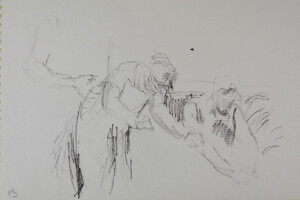 | SHORT DESCRIPTION: Drawing, pen and ink. Sketch is part of a group that documents the Chesapeake Bay Menhaden Fishery. This sketch is the thirteenth in the series and documents "The seine must be ready for the next set." NOTES: 1982.25.51 to 1982.25.67 illustrate the daily activities related to the menhaden fishery. There is a document in the file that identifies each of the images and the particular activity the image documents. The text of the document states: THE CHESAPEAKE BAY MENHADEN FISHERY, Menhaden fishboats, or pogy boats, sail between midnight and dawn, to be fishing as soon as the sun is up and spotter planes lead them to schools of bunkers. 1) The days first set. Purse boats have been sent out from the fishboat to surround a school (1982.25.51); 2) The men (captain's purse boat is at right, mate's at left) begin to draw up the seine on raised power blocks, which do the work once done by up to 40 men. (1982.25.52); 3) Purse boat to the right lists from the weight of seine and fish. (1982.25.54); 4) Fish are jumping inside the pursed seine. (1982.25.55); 5) Most of the purse seine has been drawn up and stowed in the purse boats. (1982.25.56); 6) Purse boats await the approach of the fishboat. (1982.25.57); 7) Fishboat comes alongside the seine and purse boats. (1982.25.58); 8) Purse boats form a triangle against the fishboat side. Net is raised on fishboat gaff and pump hose is lowered into mass of fish. (1982.25.59); 9) The men heave on the seine as the pump empties the pocket. (1982.25.60); 10) The emptied net is hauled aboard the purseboats. (1982.25.61); 11) These men work together as they have for years. (1982.25.62); 12) Same men. (1982.25.63); 13) The seine must be ready for the next set. (1982.25.64); 14) A winter chore, in a field ashore. (1982.25.65) 15) Two purse boats on shore at a Reedville fish factory. Purse boats, once built of cedar on oak frames, now are all aluminum. (1982.25.66); 16) Pogy boats tied up off-season at Weems shipyard, 1963. (1982.25.67) There is an untitled duplicate of sketch number 3 that is not accounted for. (1982.25.53); | CL13010 | |||||||
| 45 | 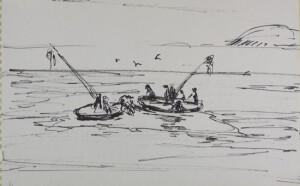 | SHORT DESCRIPTION: Drawing, pen & ink. Sketch is part of a group that documents the Chesapeake Bay Menhaden Fishery. This sketch is the sixth in the series and documents "Purse boats await the approach of the fishboat. " NOTES: 1982.25.51 to 1982.25.67 illustrate the daily activities related to the menhaden fishery. There is a document in the file that identifies each of the images and the particular activity the image documents. The text of the document states: THE CHESAPEAKE BAY MENHADEN FISHERY, Menhaden fishboats, or pogy boats, sail between midnight and dawn, to be fishing as soon as the sun is up and spotter planes lead them to schools of bunkers. 1) The days first set. Purse boats have been sent out from the fishboat to surround a school (1982.25.51); 2) The men (captain's purse boat is at right, mate's at left) begin to draw up the seine on raised power blocks, which do the work once done by up to 40 men. (1982.25.52); 3) Purse boat to the right lists from the weight of seine and fish. (1982.25.54); 4) Fish are jumping inside the pursed seine. (1982.25.55); 5) Most of the purse seine has been drawn up and stowed in the purse boats. (1982.25.56); 6) Purse boats await the approach of the fishboat. (1982.25.57); 7) Fishboat comes alongside the seine and purse boats. (1982.25.58); 8) Purse boats form a triangle against the fishboat side. Net is raised on fishboat gaff and pump hose is lowered into mass of fish. (1982.25.59); 9) The men heave on the seine as the pump empties the pocket. (1982.25.60); 10) The emptied net is hauled aboard the purseboats. (1982.25.61); 11) These men work together as they have for years. (1982.25.62); 12) Same men. (1982.25.63); 13) The seine must be ready for the next set. (1982.25.64); 14) A winter chore, in a field ashore. (1982.25.65) 15) Two purse boats on shore at a Reedville fish factory. Purse boats, once built of cedar on oak frames, now are all aluminum. (1982.25.66); 16) Pogy boats tied up off-season at Weems shipyard, 1963. (1982.25.67) There is an untitled duplicate of sketch number 3 that is not accounted for. (1982.25.53); | CL13003 | |||||||
| 46 | 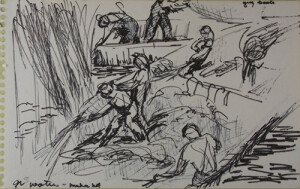 | SHORT DESCRIPTION: Drawing, pen and ink. Sketch is part of a group that documents the Chesapeake Bay Menhaden Fishery. This sketch is the eighth in the series and documents "Purse boats form a triangle against the fishboat side. Net is raised on fishboat gaff and pump hose is lowered into mass of fish. " NOTES: 1982.25.51 to 1982.25.67 illustrate the daily activities related to the menhaden fishery. There is a document in the file that identifies each of the images and the particular activity the image documents. The text of the document states: THE CHESAPEAKE BAY MENHADEN FISHERY, Menhaden fishboats, or pogy boats, sail between midnight and dawn, to be fishing as soon as the sun is up and spotter planes lead them to schools of bunkers. 1) The days first set. Purse boats have been sent out from the fishboat to surround a school (1982.25.51); 2) The men (captain's purse boat is at right, mate's at left) begin to draw up the seine on raised power blocks, which do the work once done by up to 40 men. (1982.25.52); 3) Purse boat to the right lists from the weight of seine and fish. (1982.25.54); 4) Fish are jumping inside the pursed seine. (1982.25.55); 5) Most of the purse seine has been drawn up and stowed in the purse boats. (1982.25.56); 6) Purse boats await the approach of the fishboat. (1982.25.57); 7) Fishboat comes alongside the seine and purse boats. (1982.25.58); 8) Purse boats form a triangle against the fishboat side. Net is raised on fishboat gaff and pump hose is lowered into mass of fish. (1982.25.59); 9) The men heave on the seine as the pump empties the pocket. (1982.25.60); 10) The emptied net is hauled aboard the purseboats. (1982.25.61); 11) These men work together as they have for years. (1982.25.62); 12) Same men. (1982.25.63); 13) The seine must be ready for the next set. (1982.25.64); 14) A winter chore, in a field ashore. (1982.25.65) 15) Two purse boats on shore at a Reedville fish factory. Purse boats, once built of cedar on oak frames, now are all aluminum. (1982.25.66); 16) Pogy boats tied up off-season at Weems shipyard, 1963. (1982.25.67) There is an untitled duplicate of sketch number 3 that is not accounted for. (1982.25.53); | CL13005 | |||||||
| 47 | 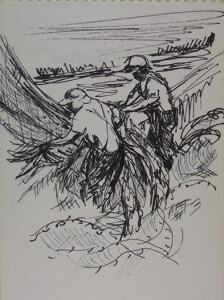 | SHORT DESCRIPTION: Drawing, pen and ink. Sketch is part of a group that documents the Chesapeake Bay Menhaden Fishery. This sketch is the twelth in the series and documents the "Same men. " NOTES: 1982.25.51 to 1982.25.67 illustrate the daily activities related to the menhaden fishery. There is a document in the file that identifies each of the images and the particular activity the image documents. The text of the document states: THE CHESAPEAKE BAY MENHADEN FISHERY, Menhaden fishboats, or pogy boats, sail between midnight and dawn, to be fishing as soon as the sun is up and spotter planes lead them to schools of bunkers. 1) The days first set. Purse boats have been sent out from the fishboat to surround a school (1982.25.51); 2) The men (captain's purse boat is at right, mate's at left) begin to draw up the seine on raised power blocks, which do the work once done by up to 40 men. (1982.25.52); 3) Purse boat to the right lists from the weight of seine and fish. (1982.25.54); 4) Fish are jumping inside the pursed seine. (1982.25.55); 5) Most of the purse seine has been drawn up and stowed in the purse boats. (1982.25.56); 6) Purse boats await the approach of the fishboat. (1982.25.57); 7) Fishboat comes alongside the seine and purse boats. (1982.25.58); 8) Purse boats form a triangle against the fishboat side. Net is raised on fishboat gaff and pump hose is lowered into mass of fish. (1982.25.59); 9) The men heave on the seine as the pump empties the pocket. (1982.25.60); 10) The emptied net is hauled aboard the purseboats. (1982.25.61); 11) These men work together as they have for years. (1982.25.62); 12) Same men. (1982.25.63); 13) The seine must be ready for the next set. (1982.25.64); 14) A winter chore, in a field ashore. (1982.25.65) 15) Two purse boats on shore at a Reedville fish factory. Purse boats, once built of cedar on oak frames, now are all aluminum. (1982.25.66); 16) Pogy boats tied up off-season at Weems shipyard, 1963. (1982.25.67) There is an untitled duplicate of sketch number 3 that is not accounted for. (1982.25.53); | CL13009 | |||||||
| 48 | 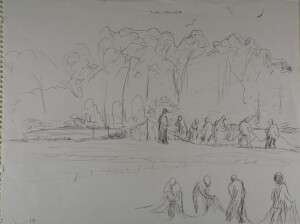 | SHORT DESCRIPTION: Drawing, pen and ink. Sketch is part of a group that documents the Chesapeake Bay Menhaden Fishery. This sketch is the fourteenth in the series and documents "A winter chore, in a field ashore." NOTES: 1982.25.51 to 1982.25.67 illustrate the daily activities related to the menhaden fishery. There is a document in the file that identifies each of the images and the particular activity the image documents. The text of the document states: THE CHESAPEAKE BAY MENHADEN FISHERY, Menhaden fishboats, or pogy boats, sail between midnight and dawn, to be fishing as soon as the sun is up and spotter planes lead them to schools of bunkers. 1) The days first set. Purse boats have been sent out from the fishboat to surround a school (1982.25.51); 2) The men (captain's purse boat is at right, mate's at left) begin to draw up the seine on raised power blocks, which do the work once done by up to 40 men. (1982.25.52); 3) Purse boat to the right lists from the weight of seine and fish. (1982.25.54); 4) Fish are jumping inside the pursed seine. (1982.25.55); 5) Most of the purse seine has been drawn up and stowed in the purse boats. (1982.25.56); 6) Purse boats await the approach of the fishboat. (1982.25.57); 7) Fishboat comes alongside the seine and purse boats. (1982.25.58); 8) Purse boats form a triangle against the fishboat side. Net is raised on fishboat gaff and pump hose is lowered into mass of fish. (1982.25.59); 9) The men heave on the seine as the pump empties the pocket. (1982.25.60); 10) The emptied net is hauled aboard the purseboats. (1982.25.61); 11) These men work together as they have for years. (1982.25.62); 12) Same men. (1982.25.63); 13) The seine must be ready for the next set. (1982.25.64); 14) A winter chore, in a field ashore. (1982.25.65) 15) Two purse boats on shore at a Reedville fish factory. Purse boats, once built of cedar on oak frames, now are all aluminum. (1982.25.66); 16) Pogy boats tied up off-season at Weems shipyard, 1963. (1982.25.67) There is an untitled duplicate of sketch number 3 that is not accounted for. (1982.25.53); | CL13011 | |||||||
| 49 | 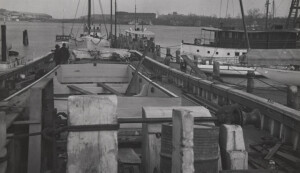 | Laforrest L. Simmons (Schooner : 1909). | noted on verso: Laforrest L. Simmons (schooner), Reedville, Va. B.1909 at Milford, Del. owned by Barney D. Wessells. | Image of forward deck while docked in a harbor. Noted on verso: At Smith's shipyard, Baltimore, being converted into a power boat; looking aft on deck, 1939. | P0001.011/01-1824#PK2825 | |||||
| 50 | 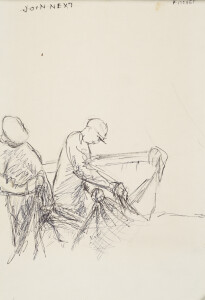 | SHORT DESCRIPTION: Drawing, pencil, pen and ink. Sketch is part of a group that documents the pound fishing in the Chesapeake Bay. This sketch is the twenty-fith in the series and documents "Net mending." NOTES: 1982.25.01 to 1982.25.31 illustrate the activities related to pound fishing in the Chesapeake Bay region. There is a document in the file that identifies each of the images and the particular activity the image documents. The text of the document states: Pound fishing. Pound nets or fish traps are fished spring and fall. An extensive herring fishery has declined during the past twenty years, partly because of offshore foreign fishing. At one time herring was a mainstay of the waterman’s winter diet, but any that is caught now goes into pet food, with a few being shipped off for pickling. Grey trout, striped bass, and blues are taken for wholesale and retail marketing. 1) The pound boat leaves its dock at dawn, timed for low tide at the nets. (1982.25.1); 2) Nets are hung on pine poles 25 to 70 feet long, and sway with wind, waves, and weight of the net. (1982.25.2); 3) Crewmen leave the pound boat in their skill to enter pound, a square at the end of a long leader extending shoreward. (1982.25.3); 4) Beginning to pull the seine. (1982.25.4); 5) Seine is pulled into a tight pocket. (1982.25.5); 6) Seine is close to the pound boat which has been anchored to a stake. (1982.25.6); 7) Aboard the pound boat, man operates a dip net, bringing fish to the hold of the pound boat. (1982.25.7); 8) Net is re-set on stakes for another catch. (1982.25.8); 9) Captain Walter Biddlecomb, 9 1973, who fished several deep water pounds off the mouth of the great Wicomico River. In earlier years he was a menhaden captain. (1982.25.9); 10) The catch is brought to the fish dock at Reedville, Va. (1982.25.10); 11) Sorting food and bait fish. (1982.25.11); 12) A casual buyer. (1982.25.12); 13) Fish is canned immediately. This was at the Harryhogan, Va. Cannery on the Yeocomico river, 1966, now closed. (1982.25.13); Another Day, Another Boat 14) Odell Fitchett, Palmer, Virginia (1982.25.14); 15) Pound net is loosened (1982.25.15); 16) Catch is pulled close to the pound boat (1982.25.16); 17) Title missing (1982.25.17); 18) More pulling (1982.25.18); 19) Dip net raises the fish (1982.25.19); 20) Pulling the dip net aboard pound boat (1982.25.20); 21) The last fish are dipped from the pound (1982.25.21); 22) Fitchett looking at slashes made in net by bluefish (1982.25.22); 23) He points (1982.25.23); 24) Net mending (1982.25.24); 25) Net mending (1982.25.25); 26) Net mending (1982.25.26); 27) Net mending, the blues took a considerable bit of the catch this time (1982.25.27); 28) Retying the pound (1982.25 28); 29) Unloading at the dock. (1982.25.29); 30) Lunch (1982.25.30); 31) Stern of the Jenny Dare, Fitchett boat (1982.25.31); | CL13049 | |||||||
| 51 | 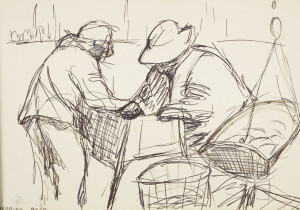 | SHORT DESCRIPTION: Drawing, pen and ink. Sketch is part of a group that documents the pound fishing in the Chesapeake Bay. This sketch is the twelfth in the series and documents "A casual buyer." NOTES: 1982.25.01 to 1982.25.31 illustrate the activities related to pound fishing in the Chesapeake Bay region. There is a document in the file that identifies each of the images and the particular activity the image documents. The text of the document states: Pound fishing. Pound nets or fish traps are fished spring and fall. An extensive herring fishery has declined during the past twenty years, partly because of offshore foreign fishing. At one time herring was a mainstay of the waterman’s winter diet, but any that is caught now goes into pet food, with a few being shipped off for pickling. Grey trout, striped bass, and blues are taken for wholesale and retail marketing. 1) The pound boat leaves its dock at dawn, timed for low tide at the nets. (1982.25.1); 2) Nets are hung on pine poles 25 to 70 feet long, and sway with wind, waves, and weight of the net. (1982.25.2); 3) Crewmen leave the pound boat in their skill to enter pound, a square at the end of a long leader extending shoreward. (1982.25.3); 4) Beginning to pull the seine. (1982.25.4); 5) Seine is pulled into a tight pocket. (1982.25.5); 6) Seine is close to the pound boat which has been anchored to a stake. (1982.25.6); 7) Aboard the pound boat, man operates a dip net, bringing fish to the hold of the pound boat. (1982.25.7); 8) Net is re-set on stakes for another catch. (1982.25.8); 9) Captain Walter Biddlecomb, 9 1973, who fished several deep water pounds off the mouth of the great Wicomico River. In earlier years he was a menhaden captain. (1982.25.9); 10) The catch is brought to the fish dock at Reedville, Va. (1982.25.10); 11) Sorting food and bait fish. (1982.25.11); 12) A casual buyer. (1982.25.12); 13) Fish is canned immediately. This was at the Harryhogan, Va. Cannery on the Yeocomico river, 1966, now closed. (1982.25.13); Another Day, Another Boat 14) Odell Fitchett, Palmer, Virginia (1982.25.14); 15) Pound net is loosened (1982.25.15); 16) Catch is pulled close to the pound boat (1982.25.16); 17) Title missing (1982.25.17); 18) More pulling (1982.25.18); 19) Dip net raises the fish (1982.25.19); 20) Pulling the dip net aboard pound boat (1982.25.20); 21) The last fish are dipped from the pound (1982.25.21); 22) Fitchett looking at slashes made in net by bluefish (1982.25.22); 23) He points (1982.25.23); 24) Net mending (1982.25.24); 25) Net mending (1982.25.25); 26) Net mending (1982.25.26); 27) Net mending, the blues took a considerable bit of the catch this time (1982.25.27); 28) Retying the pound (1982.25 28); 29) Unloading at the dock. (1982.25.29); 30) Lunch (1982.25.30); 31) Stern of the Jenny Dare, Fitchett boat (1982.25.31); | CL13062 | |||||||
| 52 | 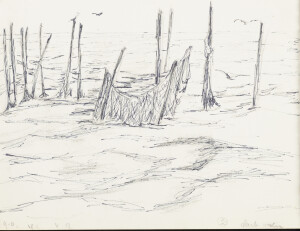 | SHORT DESCRIPTION: Drawing, pen and ink with pencil. Sketch is part of a group that documents the pound fishing in the Chesapeake Bay. This sketch is the second in the series and documents "Nets are hung on pine poles 25 to 70 feet long, and sway with wind, waves, and weight of the net." NOTES: 1982.25.01 to 1982.25.31 illustrate the activities related to pound fishing in the Chesapeake Bay region. There is a document in the file that identifies each of the images and the particular activity the image documents. The text of the document states: Pound fishing. Pound nets or fish traps are fished spring and fall. An extensive herring fishery has declined during the past twenty years, partly because of offshore foreign fishing. At one time herring was a mainstay of the waterman’s winter diet, but any that is caught now goes into pet food, with a few being shipped off for pickling. Grey trout, striped bass, and blues are taken for wholesale and retail marketing. 1) The pound boat leaves its dock at dawn, timed for low tide at the nets. (1982.25.1); 2) Nets are hung on pine poles 25 to 70 feet long, and sway with wind, waves, and weight of the net. (1982.25.2); 3) Crewmen leave the pound boat in their skill to enter pound, a square at the end of a long leader extending shoreward. (1982.25.3); 4) Beginning to pull the seine. (1982.25.4); 5) Seine is pulled into a tight pocket. (1982.25.5); 6) Seine is close to the pound boat which has been anchored to a stake. (1982.25.6); 7) Aboard the pound boat, man operates a dip net, bringing fish to the hold of the pound boat. (1982.25.7); 8) Net is re-set on stakes for another catch. (1982.25.8); 9) Captain Walter Biddlecomb, 9 1973, who fished several deep water pounds off the mouth of the great Wicomico River. In earlier years he was a menhaden captain. (1982.25.9); 10) The catch is brought to the fish dock at Reedville, Va. (1982.25.10); 11) Sorting food and bait fish. (1982.25.11); 12) A casual buyer. (1982.25.12); 13) Fish is canned immediately. This was at the Harryhogan, Va. Cannery on the Yeocomico river, 1966, now closed. (1982.25.13); Another Day, Another Boat 14) Odell Fitchett, Palmer, Virginia (1982.25.14); 15) Pound net is loosened (1982.25.15); 16) Catch is pulled close to the pound boat (1982.25.16); 17) Title missing (1982.25.17); 18) More pulling (1982.25.18); 19) Dip net raises the fish (1982.25.19); 20) Pulling the dip net aboard pound boat (1982.25.20); 21) The last fish are dipped from the pound (1982.25.21); 22) Fitchett looking at slashes made in net by bluefish (1982.25.22); 23) He points (1982.25.23); 24) Net mending (1982.25.24); 25) Net mending (1982.25.25); 26) Net mending (1982.25.26); 27) Net mending, the blues took a considerable bit of the catch this time (1982.25.27); 28) Retying the pound (1982.25 28); 29) Unloading at the dock. (1982.25.29); 30) Lunch (1982.25.30); 31) Stern of the Jenny Dare, Fitchett boat (1982.25.31); | CL13076 | |||||||
| 53 | 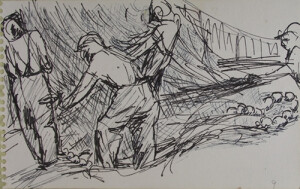 | SHORT DESCRIPTION: Drawing, pen and ink. Sketch is part of a group that documents the Chesapeake Bay Menhaden Fishery. This sketch is the ninth in the series and documents "The men heave on the seine as the pump empties the pocket. " NOTES: 1982.25.51 to 1982.25.67 illustrate the daily activities related to the menhaden fishery. There is a document in the file that identifies each of the images and the particular activity the image documents. The text of the document states: THE CHESAPEAKE BAY MENHADEN FISHERY, Menhaden fishboats, or pogy boats, sail between midnight and dawn, to be fishing as soon as the sun is up and spotter planes lead them to schools of bunkers. 1) The days first set. Purse boats have been sent out from the fishboat to surround a school (1982.25.51); 2) The men (captain's purse boat is at right, mate's at left) begin to draw up the seine on raised power blocks, which do the work once done by up to 40 men. (1982.25.52); 3) Purse boat to the right lists from the weight of seine and fish. (1982.25.54); 4) Fish are jumping inside the pursed seine. (1982.25.55); 5) Most of the purse seine has been drawn up and stowed in the purse boats. (1982.25.56); 6) Purse boats await the approach of the fishboat. (1982.25.57); 7) Fishboat comes alongside the seine and purse boats. (1982.25.58); 8) Purse boats form a triangle against the fishboat side. Net is raised on fishboat gaff and pump hose is lowered into mass of fish. (1982.25.59); 9) The men heave on the seine as the pump empties the pocket. (1982.25.60); 10) The emptied net is hauled aboard the purseboats. (1982.25.61); 11) These men work together as they have for years. (1982.25.62); 12) Same men. (1982.25.63); 13) The seine must be ready for the next set. (1982.25.64); 14) A winter chore, in a field ashore. (1982.25.65) 15) Two purse boats on shore at a Reedville fish factory. Purse boats, once built of cedar on oak frames, now are all aluminum. (1982.25.66); 16) Pogy boats tied up off-season at Weems shipyard, 1963. (1982.25.67) There is an untitled duplicate of sketch number 3 that is not accounted for. (1982.25.53); | CL13006 | |||||||
| 54 | 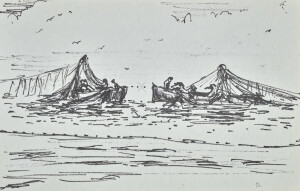 | SHORT DESCRIPTION: Drawing, pen and ink. Sketch is part of a group that documents the Chesapeake Bay Menhaden Fishery. This sketch is the second in the series and documents "The men (captain's purse boat is at the right, mate's at the left) begin to draw up the seine on raised power blocks, which do the work once done by up to 40 men." NOTES: 1982.25.51 to 1982.25.67 illustrate the daily activities related to the menhaden fishery. There is a document in the file that identifies each of the images and the particular activity the image documents. The text of the document states: THE CHESAPEAKE BAY MENHADEN FISHERY, Menhaden fishboats, or pogy boats, sail between midnight and dawn, to be fishing as soon as the sun is up and spotter planes lead them to schools of bunkers. 1) The days first set. Purse boats have been sent out from the fishboat to surround a school (1982.25.51); 2) The men (captain's purse boat is at right, mate's at left) begin to draw up the seine on raised power blocks, which do the work once done by up to 40 men. (1982.25.52); 3) Purse boat to the right lists from the weight of seine and fish. (1982.25.54); 4) Fish are jumping inside the pursed seine. (1982.25.55); 5) Most of the purse seine has been drawn up and stowed in the purse boats. (1982.25.56); 6) Purse boats await the approach of the fishboat. (1982.25.57); 7) Fishboat comes alongside the seine and purse boats. (1982.25.58); 8) Purse boats form a triangle against the fishboat side. Net is raised on fishboat gaff and pump hose is lowered into mass of fish. (1982.25.59); 9) The men heave on the seine as the pump empties the pocket. (1982.25.60); 10) The emptied net is hauled aboard the purseboats. (1982.25.61); 11) These men work together as they have for years. (1982.25.62); 12) Same men. (1982.25.63); 13) The seine must be ready for the next set. (1982.25.64); 14) A winter chore, in a field ashore. (1982.25.65) 15) Two purse boats on shore at a Reedville fish factory. Purse boats, once built of cedar on oak frames, now are all aluminum. (1982.25.66); 16) Pogy boats tied up off-season at Weems shipyard, 1963. (1982.25.67) There is an untitled duplicate of sketch number 3 that is not accounted for. (1982.25.53); | CL13024 | |||||||
| 55 | 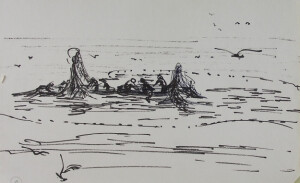 | SHORT DESCRIPTION: Drawing, pen and ink. Sketch is part of a group that documents the Chesapeake Bay Menhaden Fishery. This sketch is an untitled duplicate of sketch number 3. NOTES: 1982.25.51 to 1982.25.67 illustrate the daily activities related to the menhaden fishery. There is a document in the file that identifies each of the images and the particular activity the image documents. The text of the document states: THE CHESAPEAKE BAY MENHADEN FISHERY, Menhaden fishboats, or pogy boats, sail between midnight and dawn, to be fishing as soon as the sun is up and spotter planes lead them to schools of bunkers. 1) The days first set. Purse boats have been sent out from the fishboat to surround a school (1982.25.51); 2) The men (captain's purse boat is at right, mate's at left) begin to draw up the seine on raised power blocks, which do the work once done by up to 40 men. (1982.25.52); 3) Purse boat to the right lists from the weight of seine and fish. (1982.25.54); 4) Fish are jumping inside the pursed seine. (1982.25.55); 5) Most of the purse seine has been drawn up and stowed in the purse boats. (1982.25.56); 6) Purse boats await the approach of the fishboat. (1982.25.57); 7) Fishboat comes alongside the seine and purse boats. (1982.25.58); 8) Purse boats form a triangle against the fishboat side. Net is raised on fishboat gaff and pump hose is lowered into mass of fish. (1982.25.59); 9) The men heave on the seine as the pump empties the pocket. (1982.25.60); 10) The emptied net is hauled aboard the purseboats. (1982.25.61); 11) These men work together as they have for years. (1982.25.62); 12) Same men. (1982.25.63); 13) The seine must be ready for the next set. (1982.25.64); 14) A winter chore, in a field ashore. (1982.25.65) 15) Two purse boats on shore at a Reedville fish factory. Purse boats, once built of cedar on oak frames, now are all aluminum. (1982.25.66); 16) Pogy boats tied up off-season at Weems shipyard, 1963. (1982.25.67) There is an untitled duplicate of sketch number 3 that is not accounted for. (1982.25.53); | CL13025 | |||||||
| 56 | 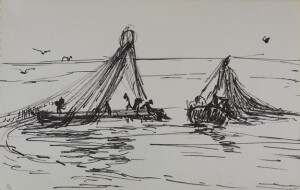 | SHORT DESCRIPTION: Drawing, pen and ink. Sketch is part of a group that documents the Chesapeake Bay Menhaden Fishery. This sketch is the third in the series and documents "Purse boat to the right lists from the weight of seine and fish." NOTES: 1982.25.51 to 1982.25.67 illustrate the daily activities related to the menhaden fishery. There is a document in the file that identifies each of the images and the particular activity the image documents. The text of the document states: THE CHESAPEAKE BAY MENHADEN FISHERY, Menhaden fishboats, or pogy boats, sail between midnight and dawn, to be fishing as soon as the sun is up and spotter planes lead them to schools of bunkers. 1) The days first set. Purse boats have been sent out from the fishboat to surround a school (1982.25.51); 2) The men (captain's purse boat is at right, mate's at left) begin to draw up the seine on raised power blocks, which do the work once done by up to 40 men. (1982.25.52); 3) Purse boat to the right lists from the weight of seine and fish. (1982.25.54); 4) Fish are jumping inside the pursed seine. (1982.25.55); 5) Most of the purse seine has been drawn up and stowed in the purse boats. (1982.25.56); 6) Purse boats await the approach of the fishboat. (1982.25.57); 7) Fishboat comes alongside the seine and purse boats. (1982.25.58); 8) Purse boats form a triangle against the fishboat side. Net is raised on fishboat gaff and pump hose is lowered into mass of fish. (1982.25.59); 9) The men heave on the seine as the pump empties the pocket. (1982.25.60); 10) The emptied net is hauled aboard the purseboats. (1982.25.61); 11) These men work together as they have for years. (1982.25.62); 12) Same men. (1982.25.63); 13) The seine must be ready for the next set. (1982.25.64); 14) A winter chore, in a field ashore. (1982.25.65) 15) Two purse boats on shore at a Reedville fish factory. Purse boats, once built of cedar on oak frames, now are all aluminum. (1982.25.66); 16) Pogy boats tied up off-season at Weems shipyard, 1963. (1982.25.67) There is an untitled duplicate of sketch number 3 that is not accounted for. (1982.25.53); | CL13026 | |||||||
| 57 | 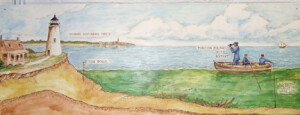 | SHORT DESCRIPTION: Acrylic painting on masonite depicting three men participating in a coastal survey. The three men are sitting in a small rowboat near shore. One man is using a sextant to measure the distance to a lighthouse and church while another uses a lead line to measure the depth of the water. The third man is using a pair of oars to maintain the boats position. The lighthouse is to the left and there is small house next to it. A tide scale sits in front of the lighthouse. A town with its church are in the background. NOTES: This painting was actually used as an exhibition prop in the Museum's former Chesapeake Bay Gallery. When the gallery was deinstalled the Museum's collections committee discussed what to do with the piece since it is an original work of art. The committee felt that it was such an elegantly simple way of illustrating the topic that it might be prove useful in the future. Collections Management staff spoke to the artist who indicated that he had created the image as part of a research project the Museum paid him to undertake as the gallery was being created. The painting was turned over to Museum once the research was complete. | CL30163 | |||||||
| 58 | 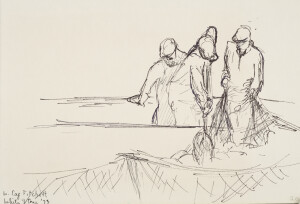 | SHORT DESCRIPTION: Drawing, pen and ink. Sketch is part of a group that documents the pound fishing in the Chesapeake Bay. This sketch is the twenty-first in the series and documents "The last fish are dipped from the pound." NOTES: 1982.25.01 to 1982.25.31 illustrate the activities related to pound fishing in the Chesapeake Bay region. There is a document in the file that identifies each of the images and the particular activity the image documents. The text of the document states: Pound fishing. Pound nets or fish traps are fished spring and fall. An extensive herring fishery has declined during the past twenty years, partly because of offshore foreign fishing. At one time herring was a mainstay of the waterman’s winter diet, but any that is caught now goes into pet food, with a few being shipped off for pickling. Grey trout, striped bass, and blues are taken for wholesale and retail marketing. 1) The pound boat leaves its dock at dawn, timed for low tide at the nets. (1982.25.1); 2) Nets are hung on pine poles 25 to 70 feet long, and sway with wind, waves, and weight of the net. (1982.25.2); 3) Crewmen leave the pound boat in their skill to enter pound, a square at the end of a long leader extending shoreward. (1982.25.3); 4) Beginning to pull the seine. (1982.25.4); 5) Seine is pulled into a tight pocket. (1982.25.5); 6) Seine is close to the pound boat which has been anchored to a stake. (1982.25.6); 7) Aboard the pound boat, man operates a dip net, bringing fish to the hold of the pound boat. (1982.25.7); 8) Net is re-set on stakes for another catch. (1982.25.8); 9) Captain Walter Biddlecomb, 9 1973, who fished several deep water pounds off the mouth of the great Wicomico River. In earlier years he was a menhaden captain. (1982.25.9); 10) The catch is brought to the fish dock at Reedville, Va. (1982.25.10); 11) Sorting food and bait fish. (1982.25.11); 12) A casual buyer. (1982.25.12); 13) Fish is canned immediately. This was at the Harryhogan, Va. Cannery on the Yeocomico river, 1966, now closed. (1982.25.13); Another Day, Another Boat 14) Odell Fitchett, Palmer, Virginia (1982.25.14); 15) Pound net is loosened (1982.25.15); 16) Catch is pulled close to the pound boat (1982.25.16); 17) Title missing (1982.25.17); 18) More pulling (1982.25.18); 19) Dip net raises the fish (1982.25.19); 20) Pulling the dip net aboard pound boat (1982.25.20); 21) The last fish are dipped from the pound (1982.25.21); 22) Fitchett looking at slashes made in net by bluefish (1982.25.22); 23) He points (1982.25.23); 24) Net mending (1982.25.24); 25) Net mending (1982.25.25); 26) Net mending (1982.25.26); 27) Net mending, the blues took a considerable bit of the catch this time (1982.25.27); 28) Retying the pound (1982.25 28); 29) Unloading at the dock. (1982.25.29); 30) Lunch (1982.25.30); 31) Stern of the Jenny Dare, Fitchett boat (1982.25.31); | CL13045 | |||||||
| 59 | 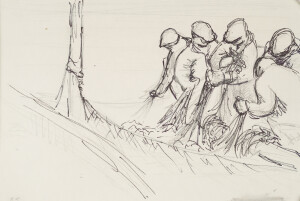 | SHORT DESCRIPTION: Drawing, pencil, pen and ink. Sketch is part of a group that documents the pound fishing in the Chesapeake Bay. This sketch is the twenty-sixth in the series and documents "Net mending." NOTES: 1982.25.01 to 1982.25.31 illustrate the activities related to pound fishing in the Chesapeake Bay region. There is a document in the file that identifies each of the images and the particular activity the image documents. The text of the document states: Pound fishing. Pound nets or fish traps are fished spring and fall. An extensive herring fishery has declined during the past twenty years, partly because of offshore foreign fishing. At one time herring was a mainstay of the waterman’s winter diet, but any that is caught now goes into pet food, with a few being shipped off for pickling. Grey trout, striped bass, and blues are taken for wholesale and retail marketing. 1) The pound boat leaves its dock at dawn, timed for low tide at the nets. (1982.25.1); 2) Nets are hung on pine poles 25 to 70 feet long, and sway with wind, waves, and weight of the net. (1982.25.2); 3) Crewmen leave the pound boat in their skill to enter pound, a square at the end of a long leader extending shoreward. (1982.25.3); 4) Beginning to pull the seine. (1982.25.4); 5) Seine is pulled into a tight pocket. (1982.25.5); 6) Seine is close to the pound boat which has been anchored to a stake. (1982.25.6); 7) Aboard the pound boat, man operates a dip net, bringing fish to the hold of the pound boat. (1982.25.7); 8) Net is re-set on stakes for another catch. (1982.25.8); 9) Captain Walter Biddlecomb, 9 1973, who fished several deep water pounds off the mouth of the great Wicomico River. In earlier years he was a menhaden captain. (1982.25.9); 10) The catch is brought to the fish dock at Reedville, Va. (1982.25.10); 11) Sorting food and bait fish. (1982.25.11); 12) A casual buyer. (1982.25.12); 13) Fish is canned immediately. This was at the Harryhogan, Va. Cannery on the Yeocomico river, 1966, now closed. (1982.25.13); Another Day, Another Boat 14) Odell Fitchett, Palmer, Virginia (1982.25.14); 15) Pound net is loosened (1982.25.15); 16) Catch is pulled close to the pound boat (1982.25.16); 17) Title missing (1982.25.17); 18) More pulling (1982.25.18); 19) Dip net raises the fish (1982.25.19); 20) Pulling the dip net aboard pound boat (1982.25.20); 21) The last fish are dipped from the pound (1982.25.21); 22) Fitchett looking at slashes made in net by bluefish (1982.25.22); 23) He points (1982.25.23); 24) Net mending (1982.25.24); 25) Net mending (1982.25.25); 26) Net mending (1982.25.26); 27) Net mending, the blues took a considerable bit of the catch this time (1982.25.27); 28) Retying the pound (1982.25 28); 29) Unloading at the dock. (1982.25.29); 30) Lunch (1982.25.30); 31) Stern of the Jenny Dare, Fitchett boat (1982.25.31); | CL13050 | |||||||
| 60 | 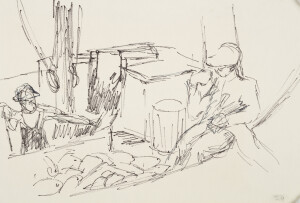 | SHORT DESCRIPTION: Drawing, pencil, pen and ink. Sketch is part of a group that documents the pound fishing in the Chesapeake Bay. This sketch is the thirtieth in the series and documents "lunch." NOTES: 1982.25.01 to 1982.25.31 illustrate the activities related to pound fishing in the Chesapeake Bay region. There is a document in the file that identifies each of the images and the particular activity the image documents. The text of the document states: Pound fishing. Pound nets or fish traps are fished spring and fall. An extensive herring fishery has declined during the past twenty years, partly because of offshore foreign fishing. At one time herring was a mainstay of the waterman’s winter diet, but any that is caught now goes into pet food, with a few being shipped off for pickling. Grey trout, striped bass, and blues are taken for wholesale and retail marketing. 1) The pound boat leaves its dock at dawn, timed for low tide at the nets. (1982.25.1); 2) Nets are hung on pine poles 25 to 70 feet long, and sway with wind, waves, and weight of the net. (1982.25.2); 3) Crewmen leave the pound boat in their skill to enter pound, a square at the end of a long leader extending shoreward. (1982.25.3); 4) Beginning to pull the seine. (1982.25.4); 5) Seine is pulled into a tight pocket. (1982.25.5); 6) Seine is close to the pound boat which has been anchored to a stake. (1982.25.6); 7) Aboard the pound boat, man operates a dip net, bringing fish to the hold of the pound boat. (1982.25.7); 8) Net is re-set on stakes for another catch. (1982.25.8); 9) Captain Walter Biddlecomb, 9 1973, who fished several deep water pounds off the mouth of the great Wicomico River. In earlier years he was a menhaden captain. (1982.25.9); 10) The catch is brought to the fish dock at Reedville, Va. (1982.25.10); 11) Sorting food and bait fish. (1982.25.11); 12) A casual buyer. (1982.25.12); 13) Fish is canned immediately. This was at the Harryhogan, Va. Cannery on the Yeocomico river, 1966, now closed. (1982.25.13); Another Day, Another Boat 14) Odell Fitchett, Palmer, Virginia (1982.25.14); 15) Pound net is loosened (1982.25.15); 16) Catch is pulled close to the pound boat (1982.25.16); 17) Title missing (1982.25.17); 18) More pulling (1982.25.18); 19) Dip net raises the fish (1982.25.19); 20) Pulling the dip net aboard pound boat (1982.25.20); 21) The last fish are dipped from the pound (1982.25.21); 22) Fitchett looking at slashes made in net by bluefish (1982.25.22); 23) He points (1982.25.23); 24) Net mending (1982.25.24); 25) Net mending (1982.25.25); 26) Net mending (1982.25.26); 27) Net mending, the blues took a considerable bit of the catch this time (1982.25.27); 28) Retying the pound (1982.25 28); 29) Unloading at the dock. (1982.25.29); 30) Lunch (1982.25.30); 31) Stern of the Jenny Dare, Fitchett boat (1982.25.31); | CL13054 | |||||||
| 61 | 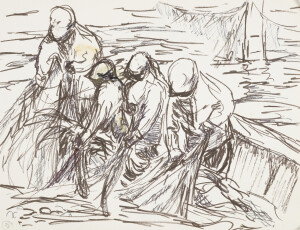 | SHORT DESCRIPTION: Drawing, pen and ink. Sketch is part of a group that documents the pound fishing in the Chesapeake Bay. This sketch is the fifth in the series and documents "Seine is pulled into a tight pocket." NOTES: 1982.25.01 to 1982.25.31 illustrate the activities related to pound fishing in the Chesapeake Bay region. There is a document in the file that identifies each of the images and the particular activity the image documents. The text of the document states: Pound fishing. Pound nets or fish traps are fished spring and fall. An extensive herring fishery has declined during the past twenty years, partly because of offshore foreign fishing. At one time herring was a mainstay of the waterman’s winter diet, but any that is caught now goes into pet food, with a few being shipped off for pickling. Grey trout, striped bass, and blues are taken for wholesale and retail marketing. 1) The pound boat leaves its dock at dawn, timed for low tide at the nets. (1982.25.1); 2) Nets are hung on pine poles 25 to 70 feet long, and sway with wind, waves, and weight of the net. (1982.25.2); 3) Crewmen leave the pound boat in their skill to enter pound, a square at the end of a long leader extending shoreward. (1982.25.3); 4) Beginning to pull the seine. (1982.25.4); 5) Seine is pulled into a tight pocket. (1982.25.5); 6) Seine is close to the pound boat which has been anchored to a stake. (1982.25.6); 7) Aboard the pound boat, man operates a dip net, bringing fish to the hold of the pound boat. (1982.25.7); 8) Net is re-set on stakes for another catch. (1982.25.8); 9) Captain Walter Biddlecomb, 9 1973, who fished several deep water pounds off the mouth of the great Wicomico River. In earlier years he was a menhaden captain. (1982.25.9); 10) The catch is brought to the fish dock at Reedville, Va. (1982.25.10); 11) Sorting food and bait fish. (1982.25.11); 12) A casual buyer. (1982.25.12); 13) Fish is canned immediately. This was at the Harryhogan, Va. Cannery on the Yeocomico river, 1966, now closed. (1982.25.13); Another Day, Another Boat 14) Odell Fitchett, Palmer, Virginia (1982.25.14); 15) Pound net is loosened (1982.25.15); 16) Catch is pulled close to the pound boat (1982.25.16); 17) Title missing (1982.25.17); 18) More pulling (1982.25.18); 19) Dip net raises the fish (1982.25.19); 20) Pulling the dip net aboard pound boat (1982.25.20); 21) The last fish are dipped from the pound (1982.25.21); 22) Fitchett looking at slashes made in net by bluefish (1982.25.22); 23) He points (1982.25.23); 24) Net mending (1982.25.24); 25) Net mending (1982.25.25); 26) Net mending (1982.25.26); 27) Net mending, the blues took a considerable bit of the catch this time (1982.25.27); 28) Retying the pound (1982.25 28); 29) Unloading at the dock. (1982.25.29); 30) Lunch (1982.25.30); 31) Stern of the Jenny Dare, Fitchett boat (1982.25.31); | CL13055 | |||||||
| 62 | 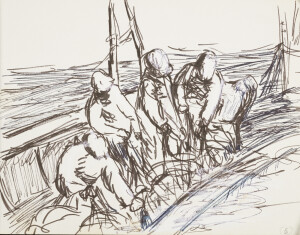 | SHORT DESCRIPTION: Drawing, pen and ink with wash. Sketch is part of a group that documents the pound fishing in the Chesapeake Bay. This sketch is the sixth in the series and documents "Seine is close to the pound boat which has been anchored to a stake." NOTES: 1982.25.01 to 1982.25.31 illustrate the activities related to pound fishing in the Chesapeake Bay region. There is a document in the file that identifies each of the images and the particular activity the image documents. The text of the document states: Pound fishing. Pound nets or fish traps are fished spring and fall. An extensive herring fishery has declined during the past twenty years, partly because of offshore foreign fishing. At one time herring was a mainstay of the waterman’s winter diet, but any that is caught now goes into pet food, with a few being shipped off for pickling. Grey trout, striped bass, and blues are taken for wholesale and retail marketing. 1) The pound boat leaves its dock at dawn, timed for low tide at the nets. (1982.25.1); 2) Nets are hung on pine poles 25 to 70 feet long, and sway with wind, waves, and weight of the net. (1982.25.2); 3) Crewmen leave the pound boat in their skill to enter pound, a square at the end of a long leader extending shoreward. (1982.25.3); 4) Beginning to pull the seine. (1982.25.4); 5) Seine is pulled into a tight pocket. (1982.25.5); 6) Seine is close to the pound boat which has been anchored to a stake. (1982.25.6); 7) Aboard the pound boat, man operates a dip net, bringing fish to the hold of the pound boat. (1982.25.7); 8) Net is re-set on stakes for another catch. (1982.25.8); 9) Captain Walter Biddlecomb, 9 1973, who fished several deep water pounds off the mouth of the great Wicomico River. In earlier years he was a menhaden captain. (1982.25.9); 10) The catch is brought to the fish dock at Reedville, Va. (1982.25.10); 11) Sorting food and bait fish. (1982.25.11); 12) A casual buyer. (1982.25.12); 13) Fish is canned immediately. This was at the Harryhogan, Va. Cannery on the Yeocomico river, 1966, now closed. (1982.25.13); Another Day, Another Boat 14) Odell Fitchett, Palmer, Virginia (1982.25.14); 15) Pound net is loosened (1982.25.15); 16) Catch is pulled close to the pound boat (1982.25.16); 17) Title missing (1982.25.17); 18) More pulling (1982.25.18); 19) Dip net raises the fish (1982.25.19); 20) Pulling the dip net aboard pound boat (1982.25.20); 21) The last fish are dipped from the pound (1982.25.21); 22) Fitchett looking at slashes made in net by bluefish (1982.25.22); 23) He points (1982.25.23); 24) Net mending (1982.25.24); 25) Net mending (1982.25.25); 26) Net mending (1982.25.26); 27) Net mending, the blues took a considerable bit of the catch this time (1982.25.27); 28) Retying the pound (1982.25 28); 29) Unloading at the dock. (1982.25.29); 30) Lunch (1982.25.30); 31) Stern of the Jenny Dare, Fitchett boat (1982.25.31); | CL13056 | |||||||
| 63 | 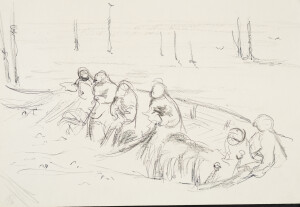 | SHORT DESCRIPTION: Drawing, pencil, pen and ink. Sketch is part of a group that documents the pound fishing in the Chesapeake Bay. This sketch is the seventeeth in the series and is untitled. NOTES: 1982.25.01 to 1982.25.31 illustrate the activities related to pound fishing in the Chesapeake Bay region. There is a document in the file that identifies each of the images and the particular activity the image documents. The text of the document states: Pound fishing. Pound nets or fish traps are fished spring and fall. An extensive herring fishery has declined during the past twenty years, partly because of offshore foreign fishing. At one time herring was a mainstay of the waterman’s winter diet, but any that is caught now goes into pet food, with a few being shipped off for pickling. Grey trout, striped bass, and blues are taken for wholesale and retail marketing. 1) The pound boat leaves its dock at dawn, timed for low tide at the nets. (1982.25.1); 2) Nets are hung on pine poles 25 to 70 feet long, and sway with wind, waves, and weight of the net. (1982.25.2); 3) Crewmen leave the pound boat in their skill to enter pound, a square at the end of a long leader extending shoreward. (1982.25.3); 4) Beginning to pull the seine. (1982.25.4); 5) Seine is pulled into a tight pocket. (1982.25.5); 6) Seine is close to the pound boat which has been anchored to a stake. (1982.25.6); 7) Aboard the pound boat, man operates a dip net, bringing fish to the hold of the pound boat. (1982.25.7); 8) Net is re-set on stakes for another catch. (1982.25.8); 9) Captain Walter Biddlecomb, 9 1973, who fished several deep water pounds off the mouth of the great Wicomico River. In earlier years he was a menhaden captain. (1982.25.9); 10) The catch is brought to the fish dock at Reedville, Va. (1982.25.10); 11) Sorting food and bait fish. (1982.25.11); 12) A casual buyer. (1982.25.12); 13) Fish is canned immediately. This was at the Harryhogan, Va. Cannery on the Yeocomico river, 1966, now closed. (1982.25.13); Another Day, Another Boat 14) Odell Fitchett, Palmer, Virginia (1982.25.14); 15) Pound net is loosened (1982.25.15); 16) Catch is pulled close to the pound boat (1982.25.16); 17) Title missing (1982.25.17); 18) More pulling (1982.25.18); 19) Dip net raises the fish (1982.25.19); 20) Pulling the dip net aboard pound boat (1982.25.20); 21) The last fish are dipped from the pound (1982.25.21); 22) Fitchett looking at slashes made in net by bluefish (1982.25.22); 23) He points (1982.25.23); 24) Net mending (1982.25.24); 25) Net mending (1982.25.25); 26) Net mending (1982.25.26); 27) Net mending, the blues took a considerable bit of the catch this time (1982.25.27); 28) Retying the pound (1982.25 28); 29) Unloading at the dock. (1982.25.29); 30) Lunch (1982.25.30); 31) Stern of the Jenny Dare, Fitchett boat (1982.25.31); | CL13067 | |||||||
| 64 | 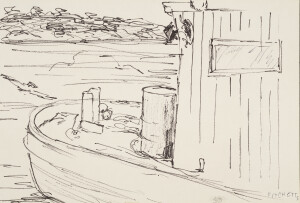 | SHORT DESCRIPTION: Drawing, pencil, pen and ink. Sketch is part of a group that documents the pound fishing in the Chesapeake Bay. This sketch is the thirty-first in the series and documents "Stern of the Jenny Dare, Fitchett boat." NOTES: 1982.25.01 to 1982.25.31 illustrate the activities related to pound fishing in the Chesapeake Bay region. There is a document in the file that identifies each of the images and the particular activity the image documents. The text of the document states: Pound fishing. Pound nets or fish traps are fished spring and fall. An extensive herring fishery has declined during the past twenty years, partly because of offshore foreign fishing. At one time herring was a mainstay of the waterman’s winter diet, but any that is caught now goes into pet food, with a few being shipped off for pickling. Grey trout, striped bass, and blues are taken for wholesale and retail marketing. 1) The pound boat leaves its dock at dawn, timed for low tide at the nets. (1982.25.1); 2) Nets are hung on pine poles 25 to 70 feet long, and sway with wind, waves, and weight of the net. (1982.25.2); 3) Crewmen leave the pound boat in their skill to enter pound, a square at the end of a long leader extending shoreward. (1982.25.3); 4) Beginning to pull the seine. (1982.25.4); 5) Seine is pulled into a tight pocket. (1982.25.5); 6) Seine is close to the pound boat which has been anchored to a stake. (1982.25.6); 7) Aboard the pound boat, man operates a dip net, bringing fish to the hold of the pound boat. (1982.25.7); 8) Net is re-set on stakes for another catch. (1982.25.8); 9) Captain Walter Biddlecomb, 9 1973, who fished several deep water pounds off the mouth of the great Wicomico River. In earlier years he was a menhaden captain. (1982.25.9); 10) The catch is brought to the fish dock at Reedville, Va. (1982.25.10); 11) Sorting food and bait fish. (1982.25.11); 12) A casual buyer. (1982.25.12); 13) Fish is canned immediately. This was at the Harryhogan, Va. Cannery on the Yeocomico river, 1966, now closed. (1982.25.13); Another Day, Another Boat 14) Odell Fitchett, Palmer, Virginia (1982.25.14); 15) Pound net is loosened (1982.25.15); 16) Catch is pulled close to the pound boat (1982.25.16); 17) Title missing (1982.25.17); 18) More pulling (1982.25.18); 19) Dip net raises the fish (1982.25.19); 20) Pulling the dip net aboard pound boat (1982.25.20); 21) The last fish are dipped from the pound (1982.25.21); 22) Fitchett looking at slashes made in net by bluefish (1982.25.22); 23) He points (1982.25.23); 24) Net mending (1982.25.24); 25) Net mending (1982.25.25); 26) Net mending (1982.25.26); 27) Net mending, the blues took a considerable bit of the catch this time (1982.25.27); 28) Retying the pound (1982.25 28); 29) Unloading at the dock. (1982.25.29); 30) Lunch (1982.25.30); 31) Stern of the Jenny Dare, Fitchett boat (1982.25.31); | CL13029 | |||||||
| 65 | 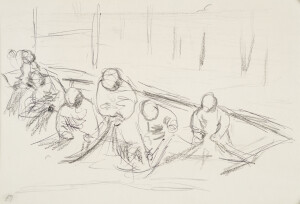 | SHORT DESCRIPTION: Drawing, pencil, pen and ink. Sketch is part of a group that documents the pound fishing in the Chesapeake Bay. This sketch is the eighteenth in the series and documents "More pulling." NOTES: 1982.25.01 to 1982.25.31 illustrate the activities related to pound fishing in the Chesapeake Bay region. There is a document in the file that identifies each of the images and the particular activity the image documents. The text of the document states: Pound fishing. Pound nets or fish traps are fished spring and fall. An extensive herring fishery has declined during the past twenty years, partly because of offshore foreign fishing. At one time herring was a mainstay of the waterman’s winter diet, but any that is caught now goes into pet food, with a few being shipped off for pickling. Grey trout, striped bass, and blues are taken for wholesale and retail marketing. 1) The pound boat leaves its dock at dawn, timed for low tide at the nets. (1982.25.1); 2) Nets are hung on pine poles 25 to 70 feet long, and sway with wind, waves, and weight of the net. (1982.25.2); 3) Crewmen leave the pound boat in their skill to enter pound, a square at the end of a long leader extending shoreward. (1982.25.3); 4) Beginning to pull the seine. (1982.25.4); 5) Seine is pulled into a tight pocket. (1982.25.5); 6) Seine is close to the pound boat which has been anchored to a stake. (1982.25.6); 7) Aboard the pound boat, man operates a dip net, bringing fish to the hold of the pound boat. (1982.25.7); 8) Net is re-set on stakes for another catch. (1982.25.8); 9) Captain Walter Biddlecomb, 9 1973, who fished several deep water pounds off the mouth of the great Wicomico River. In earlier years he was a menhaden captain. (1982.25.9); 10) The catch is brought to the fish dock at Reedville, Va. (1982.25.10); 11) Sorting food and bait fish. (1982.25.11); 12) A casual buyer. (1982.25.12); 13) Fish is canned immediately. This was at the Harryhogan, Va. Cannery on the Yeocomico river, 1966, now closed. (1982.25.13); Another Day, Another Boat 14) Odell Fitchett, Palmer, Virginia (1982.25.14); 15) Pound net is loosened (1982.25.15); 16) Catch is pulled close to the pound boat (1982.25.16); 17) Title missing (1982.25.17); 18) More pulling (1982.25.18); 19) Dip net raises the fish (1982.25.19); 20) Pulling the dip net aboard pound boat (1982.25.20); 21) The last fish are dipped from the pound (1982.25.21); 22) Fitchett looking at slashes made in net by bluefish (1982.25.22); 23) He points (1982.25.23); 24) Net mending (1982.25.24); 25) Net mending (1982.25.25); 26) Net mending (1982.25.26); 27) Net mending, the blues took a considerable bit of the catch this time (1982.25.27); 28) Retying the pound (1982.25 28); 29) Unloading at the dock. (1982.25.29); 30) Lunch (1982.25.30); 31) Stern of the Jenny Dare, Fitchett boat (1982.25.31); | CL13042 | |||||||
| 66 | 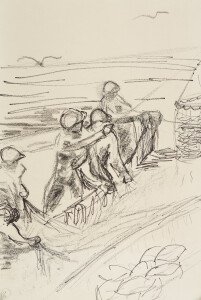 | SHORT DESCRIPTION: Drawing, pencil, pen and ink. Sketch is part of a group that documents the pound fishing in the Chesapeake Bay. This sketch is the nineteenth in the series and documents "Dip net raises the fish." NOTES: 1982.25.01 to 1982.25.31 illustrate the activities related to pound fishing in the Chesapeake Bay region. There is a document in the file that identifies each of the images and the particular activity the image documents. The text of the document states: Pound fishing. Pound nets or fish traps are fished spring and fall. An extensive herring fishery has declined during the past twenty years, partly because of offshore foreign fishing. At one time herring was a mainstay of the waterman’s winter diet, but any that is caught now goes into pet food, with a few being shipped off for pickling. Grey trout, striped bass, and blues are taken for wholesale and retail marketing. 1) The pound boat leaves its dock at dawn, timed for low tide at the nets. (1982.25.1); 2) Nets are hung on pine poles 25 to 70 feet long, and sway with wind, waves, and weight of the net. (1982.25.2); 3) Crewmen leave the pound boat in their skill to enter pound, a square at the end of a long leader extending shoreward. (1982.25.3); 4) Beginning to pull the seine. (1982.25.4); 5) Seine is pulled into a tight pocket. (1982.25.5); 6) Seine is close to the pound boat which has been anchored to a stake. (1982.25.6); 7) Aboard the pound boat, man operates a dip net, bringing fish to the hold of the pound boat. (1982.25.7); 8) Net is re-set on stakes for another catch. (1982.25.8); 9) Captain Walter Biddlecomb, 9 1973, who fished several deep water pounds off the mouth of the great Wicomico River. In earlier years he was a menhaden captain. (1982.25.9); 10) The catch is brought to the fish dock at Reedville, Va. (1982.25.10); 11) Sorting food and bait fish. (1982.25.11); 12) A casual buyer. (1982.25.12); 13) Fish is canned immediately. This was at the Harryhogan, Va. Cannery on the Yeocomico river, 1966, now closed. (1982.25.13); Another Day, Another Boat 14) Odell Fitchett, Palmer, Virginia (1982.25.14); 15) Pound net is loosened (1982.25.15); 16) Catch is pulled close to the pound boat (1982.25.16); 17) Title missing (1982.25.17); 18) More pulling (1982.25.18); 19) Dip net raises the fish (1982.25.19); 20) Pulling the dip net aboard pound boat (1982.25.20); 21) The last fish are dipped from the pound (1982.25.21); 22) Fitchett looking at slashes made in net by bluefish (1982.25.22); 23) He points (1982.25.23); 24) Net mending (1982.25.24); 25) Net mending (1982.25.25); 26) Net mending (1982.25.26); 27) Net mending, the blues took a considerable bit of the catch this time (1982.25.27); 28) Retying the pound (1982.25 28); 29) Unloading at the dock. (1982.25.29); 30) Lunch (1982.25.30); 31) Stern of the Jenny Dare, Fitchett boat (1982.25.31); | CL13043 | |||||||
| 67 | 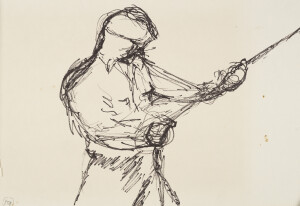 | SHORT DESCRIPTION: Drawing, pen and ink. Sketch is part of a group that documents the pound fishing in the Chesapeake Bay. This sketch is the twentieth in the series and documents "Pulling the dip net aboard pound boat." NOTES: 1982.25.01 to 1982.25.31 illustrate the activities related to pound fishing in the Chesapeake Bay region. There is a document in the file that identifies each of the images and the particular activity the image documents. The text of the document states: Pound fishing. Pound nets or fish traps are fished spring and fall. An extensive herring fishery has declined during the past twenty years, partly because of offshore foreign fishing. At one time herring was a mainstay of the waterman’s winter diet, but any that is caught now goes into pet food, with a few being shipped off for pickling. Grey trout, striped bass, and blues are taken for wholesale and retail marketing. 1) The pound boat leaves its dock at dawn, timed for low tide at the nets. (1982.25.1); 2) Nets are hung on pine poles 25 to 70 feet long, and sway with wind, waves, and weight of the net. (1982.25.2); 3) Crewmen leave the pound boat in their skill to enter pound, a square at the end of a long leader extending shoreward. (1982.25.3); 4) Beginning to pull the seine. (1982.25.4); 5) Seine is pulled into a tight pocket. (1982.25.5); 6) Seine is close to the pound boat which has been anchored to a stake. (1982.25.6); 7) Aboard the pound boat, man operates a dip net, bringing fish to the hold of the pound boat. (1982.25.7); 8) Net is re-set on stakes for another catch. (1982.25.8); 9) Captain Walter Biddlecomb, 9 1973, who fished several deep water pounds off the mouth of the great Wicomico River. In earlier years he was a menhaden captain. (1982.25.9); 10) The catch is brought to the fish dock at Reedville, Va. (1982.25.10); 11) Sorting food and bait fish. (1982.25.11); 12) A casual buyer. (1982.25.12); 13) Fish is canned immediately. This was at the Harryhogan, Va. Cannery on the Yeocomico river, 1966, now closed. (1982.25.13); Another Day, Another Boat 14) Odell Fitchett, Palmer, Virginia (1982.25.14); 15) Pound net is loosened (1982.25.15); 16) Catch is pulled close to the pound boat (1982.25.16); 17) Title missing (1982.25.17); 18) More pulling (1982.25.18); 19) Dip net raises the fish (1982.25.19); 20) Pulling the dip net aboard pound boat (1982.25.20); 21) The last fish are dipped from the pound (1982.25.21); 22) Fitchett looking at slashes made in net by bluefish (1982.25.22); 23) He points (1982.25.23); 24) Net mending (1982.25.24); 25) Net mending (1982.25.25); 26) Net mending (1982.25.26); 27) Net mending, the blues took a considerable bit of the catch this time (1982.25.27); 28) Retying the pound (1982.25 28); 29) Unloading at the dock. (1982.25.29); 30) Lunch (1982.25.30); 31) Stern of the Jenny Dare, Fitchett boat (1982.25.31); | CL13044 | |||||||
| 68 | 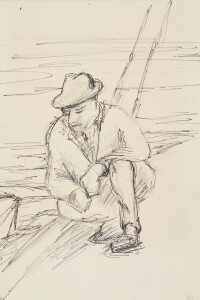 | SHORT DESCRIPTION: Drawing, pencil, pen and ink. Sketch is part of a group that documents the pound fishing in the Chesapeake Bay. This sketch is the twenty-second in the series and documents "Fitchett looking at slashes made in net by bluefish." NOTES: 1982.25.01 to 1982.25.31 illustrate the activities related to pound fishing in the Chesapeake Bay region. There is a document in the file that identifies each of the images and the particular activity the image documents. The text of the document states: Pound fishing. Pound nets or fish traps are fished spring and fall. An extensive herring fishery has declined during the past twenty years, partly because of offshore foreign fishing. At one time herring was a mainstay of the waterman’s winter diet, but any that is caught now goes into pet food, with a few being shipped off for pickling. Grey trout, striped bass, and blues are taken for wholesale and retail marketing. 1) The pound boat leaves its dock at dawn, timed for low tide at the nets. (1982.25.1); 2) Nets are hung on pine poles 25 to 70 feet long, and sway with wind, waves, and weight of the net. (1982.25.2); 3) Crewmen leave the pound boat in their skill to enter pound, a square at the end of a long leader extending shoreward. (1982.25.3); 4) Beginning to pull the seine. (1982.25.4); 5) Seine is pulled into a tight pocket. (1982.25.5); 6) Seine is close to the pound boat which has been anchored to a stake. (1982.25.6); 7) Aboard the pound boat, man operates a dip net, bringing fish to the hold of the pound boat. (1982.25.7); 8) Net is re-set on stakes for another catch. (1982.25.8); 9) Captain Walter Biddlecomb, 9 1973, who fished several deep water pounds off the mouth of the great Wicomico River. In earlier years he was a menhaden captain. (1982.25.9); 10) The catch is brought to the fish dock at Reedville, Va. (1982.25.10); 11) Sorting food and bait fish. (1982.25.11); 12) A casual buyer. (1982.25.12); 13) Fish is canned immediately. This was at the Harryhogan, Va. Cannery on the Yeocomico river, 1966, now closed. (1982.25.13); Another Day, Another Boat 14) Odell Fitchett, Palmer, Virginia (1982.25.14); 15) Pound net is loosened (1982.25.15); 16) Catch is pulled close to the pound boat (1982.25.16); 17) Title missing (1982.25.17); 18) More pulling (1982.25.18); 19) Dip net raises the fish (1982.25.19); 20) Pulling the dip net aboard pound boat (1982.25.20); 21) The last fish are dipped from the pound (1982.25.21); 22) Fitchett looking at slashes made in net by bluefish (1982.25.22); 23) He points (1982.25.23); 24) Net mending (1982.25.24); 25) Net mending (1982.25.25); 26) Net mending (1982.25.26); 27) Net mending, the blues took a considerable bit of the catch this time (1982.25.27); 28) Retying the pound (1982.25 28); 29) Unloading at the dock. (1982.25.29); 30) Lunch (1982.25.30); 31) Stern of the Jenny Dare, Fitchett boat (1982.25.31); | CL13046 | |||||||
| 69 | 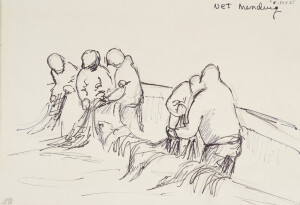 | SHORT DESCRIPTION: Drawing, pencil, pen and ink. Sketch is part of a group that documents the pound fishing in the Chesapeake Bay. This sketch is the twenty-fourth in the series and documents "Net mending." NOTES: 1982.25.01 to 1982.25.31 illustrate the activities related to pound fishing in the Chesapeake Bay region. There is a document in the file that identifies each of the images and the particular activity the image documents. The text of the document states: Pound fishing. Pound nets or fish traps are fished spring and fall. An extensive herring fishery has declined during the past twenty years, partly because of offshore foreign fishing. At one time herring was a mainstay of the waterman’s winter diet, but any that is caught now goes into pet food, with a few being shipped off for pickling. Grey trout, striped bass, and blues are taken for wholesale and retail marketing. 1) The pound boat leaves its dock at dawn, timed for low tide at the nets. (1982.25.1); 2) Nets are hung on pine poles 25 to 70 feet long, and sway with wind, waves, and weight of the net. (1982.25.2); 3) Crewmen leave the pound boat in their skill to enter pound, a square at the end of a long leader extending shoreward. (1982.25.3); 4) Beginning to pull the seine. (1982.25.4); 5) Seine is pulled into a tight pocket. (1982.25.5); 6) Seine is close to the pound boat which has been anchored to a stake. (1982.25.6); 7) Aboard the pound boat, man operates a dip net, bringing fish to the hold of the pound boat. (1982.25.7); 8) Net is re-set on stakes for another catch. (1982.25.8); 9) Captain Walter Biddlecomb, 9 1973, who fished several deep water pounds off the mouth of the great Wicomico River. In earlier years he was a menhaden captain. (1982.25.9); 10) The catch is brought to the fish dock at Reedville, Va. (1982.25.10); 11) Sorting food and bait fish. (1982.25.11); 12) A casual buyer. (1982.25.12); 13) Fish is canned immediately. This was at the Harryhogan, Va. Cannery on the Yeocomico river, 1966, now closed. (1982.25.13); Another Day, Another Boat 14) Odell Fitchett, Palmer, Virginia (1982.25.14); 15) Pound net is loosened (1982.25.15); 16) Catch is pulled close to the pound boat (1982.25.16); 17) Title missing (1982.25.17); 18) More pulling (1982.25.18); 19) Dip net raises the fish (1982.25.19); 20) Pulling the dip net aboard pound boat (1982.25.20); 21) The last fish are dipped from the pound (1982.25.21); 22) Fitchett looking at slashes made in net by bluefish (1982.25.22); 23) He points (1982.25.23); 24) Net mending (1982.25.24); 25) Net mending (1982.25.25); 26) Net mending (1982.25.26); 27) Net mending, the blues took a considerable bit of the catch this time (1982.25.27); 28) Retying the pound (1982.25 28); 29) Unloading at the dock. (1982.25.29); 30) Lunch (1982.25.30); 31) Stern of the Jenny Dare, Fitchett boat (1982.25.31); | CL13048 | |||||||
| 70 | 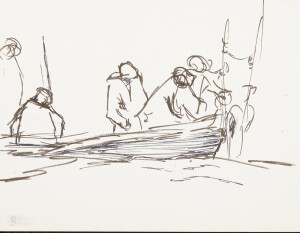 | SHORT DESCRIPTION: Drawing, pen and ink. Sketch is part of a group that documents the pound fishing in the Chesapeake Bay. This sketch is the third in the series and documents "Crewmen leave the pound boat in their skill to enter pound, a square at the end of a long leader extending shoreward." NOTES: 1982.25.01 to 1982.25.31 illustrate the activities related to pound fishing in the Chesapeake Bay region. There is a document in the file that identifies each of the images and the particular activity the image documents. The text of the document states: Pound fishing. Pound nets or fish traps are fished spring and fall. An extensive herring fishery has declined during the past twenty years, partly because of offshore foreign fishing. At one time herring was a mainstay of the waterman’s winter diet, but any that is caught now goes into pet food, with a few being shipped off for pickling. Grey trout, striped bass, and blues are taken for wholesale and retail marketing. 1) The pound boat leaves its dock at dawn, timed for low tide at the nets. (1982.25.1); 2) Nets are hung on pine poles 25 to 70 feet long, and sway with wind, waves, and weight of the net. (1982.25.2); 3) Crewmen leave the pound boat in their skill to enter pound, a square at the end of a long leader extending shoreward. (1982.25.3); 4) Beginning to pull the seine. (1982.25.4); 5) Seine is pulled into a tight pocket. (1982.25.5); 6) Seine is close to the pound boat which has been anchored to a stake. (1982.25.6); 7) Aboard the pound boat, man operates a dip net, bringing fish to the hold of the pound boat. (1982.25.7); 8) Net is re-set on stakes for another catch. (1982.25.8); 9) Captain Walter Biddlecomb, 9 1973, who fished several deep water pounds off the mouth of the great Wicomico River. In earlier years he was a menhaden captain. (1982.25.9); 10) The catch is brought to the fish dock at Reedville, Va. (1982.25.10); 11) Sorting food and bait fish. (1982.25.11); 12) A casual buyer. (1982.25.12); 13) Fish is canned immediately. This was at the Harryhogan, Va. Cannery on the Yeocomico river, 1966, now closed. (1982.25.13); Another Day, Another Boat 14) Odell Fitchett, Palmer, Virginia (1982.25.14); 15) Pound net is loosened (1982.25.15); 16) Catch is pulled close to the pound boat (1982.25.16); 17) Title missing (1982.25.17); 18) More pulling (1982.25.18); 19) Dip net raises the fish (1982.25.19); 20) Pulling the dip net aboard pound boat (1982.25.20); 21) The last fish are dipped from the pound (1982.25.21); 22) Fitchett looking at slashes made in net by bluefish (1982.25.22); 23) He points (1982.25.23); 24) Net mending (1982.25.24); 25) Net mending (1982.25.25); 26) Net mending (1982.25.26); 27) Net mending, the blues took a considerable bit of the catch this time (1982.25.27); 28) Retying the pound (1982.25 28); 29) Unloading at the dock. (1982.25.29); 30) Lunch (1982.25.30); 31) Stern of the Jenny Dare, Fitchett boat (1982.25.31); | CL13077 | |||||||
| 71 | 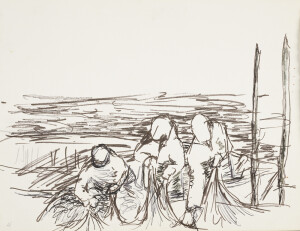 | SHORT DESCRIPTION: Drawing, pen and ink. Sketch is part of a group that documents the pound fishing in the Chesapeake Bay. This sketch is the fourth in the series and documents "Beginning to pull the seine." NOTES: 1982.25.01 to 1982.25.31 illustrate the activities related to pound fishing in the Chesapeake Bay region. There is a document in the file that identifies each of the images and the particular activity the image documents. The text of the document states: Pound fishing. Pound nets or fish traps are fished spring and fall. An extensive herring fishery has declined during the past twenty years, partly because of offshore foreign fishing. At one time herring was a mainstay of the waterman’s winter diet, but any that is caught now goes into pet food, with a few being shipped off for pickling. Grey trout, striped bass, and blues are taken for wholesale and retail marketing. 1) The pound boat leaves its dock at dawn, timed for low tide at the nets. (1982.25.1); 2) Nets are hung on pine poles 25 to 70 feet long, and sway with wind, waves, and weight of the net. (1982.25.2); 3) Crewmen leave the pound boat in their skill to enter pound, a square at the end of a long leader extending shoreward. (1982.25.3); 4) Beginning to pull the seine. (1982.25.4); 5) Seine is pulled into a tight pocket. (1982.25.5); 6) Seine is close to the pound boat which has been anchored to a stake. (1982.25.6); 7) Aboard the pound boat, man operates a dip net, bringing fish to the hold of the pound boat. (1982.25.7); 8) Net is re-set on stakes for another catch. (1982.25.8); 9) Captain Walter Biddlecomb, 9 1973, who fished several deep water pounds off the mouth of the great Wicomico River. In earlier years he was a menhaden captain. (1982.25.9); 10) The catch is brought to the fish dock at Reedville, Va. (1982.25.10); 11) Sorting food and bait fish. (1982.25.11); 12) A casual buyer. (1982.25.12); 13) Fish is canned immediately. This was at the Harryhogan, Va. Cannery on the Yeocomico river, 1966, now closed. (1982.25.13); Another Day, Another Boat 14) Odell Fitchett, Palmer, Virginia (1982.25.14); 15) Pound net is loosened (1982.25.15); 16) Catch is pulled close to the pound boat (1982.25.16); 17) Title missing (1982.25.17); 18) More pulling (1982.25.18); 19) Dip net raises the fish (1982.25.19); 20) Pulling the dip net aboard pound boat (1982.25.20); 21) The last fish are dipped from the pound (1982.25.21); 22) Fitchett looking at slashes made in net by bluefish (1982.25.22); 23) He points (1982.25.23); 24) Net mending (1982.25.24); 25) Net mending (1982.25.25); 26) Net mending (1982.25.26); 27) Net mending, the blues took a considerable bit of the catch this time (1982.25.27); 28) Retying the pound (1982.25 28); 29) Unloading at the dock. (1982.25.29); 30) Lunch (1982.25.30); 31) Stern of the Jenny Dare, Fitchett boat (1982.25.31); | CL13078 | |||||||
| 72 |    | Circa 1933-1980 | Virginia Institute of Marine Science–Photographs.; Reedville Oil & Guano Co. Photographs.; Glebe Point Boat Company, Inc. Photographs. | Chesapeake Bay Region (Md. and Va.)–Photographs.; Coan River (Va.)–Photographs.; Tangier Island (Va.)–Photographs.; Cove Point (Md.)–Photographs.; Smith Island (Md. and Va.)–Photographs.; Reedville (Va.)–Photographs. | Work boats–Chesapeake Bay Region (Md. and Va.)–Photographs.; Fishing boats–Chesapeake Bay Region (Md. and Va.)–Photographs.; Yachts–Chesapeake Bay Region (Md. and Va.)–Photographs.; Canoes and canoeing–Chesapeake Bay Region (Md. and Va.)–Photographs.; Lobster boats–Chesapeake Bay Region (Md. and Va.)–Photographs.; Menhaden industry–Chesapeake Bay Region (Md. and Va.)–Photographs.; Herring industry–Chesapeake Bay Region (Md. and Va.)–Photographs.; Boatbuilding–Chesapeake Bay Region (Md. and Va.)–Photographs.; Boatyards–Chesapeake Bay Region (Md. and Va.)–Photographs.; Marine railways–Chesapeake Bay Region (Md. and Va.)–Photographs.; Marinas–Chesapeake Bay Region (Md. and Va.)–Photographs. | Contains photographic negatives of workboats, yachts, fishing boats, lobster boats, Miller's marine railway, boat owner Joe Christmas, the boat "Friendship", the boat "David Scott", the boat "Annapolis", the boat "Captain Thomas", Fairport docks, the boat "Doralana II", Tangier Island, the boat "Galadriel", Glebe Point Boat Company, Coan river marina in Fairport, the boat "Kung Fu Tse", menhaden, herring and herring roe, Johns Hopkins research boat, tugboats, the boat "Allen W. Haynie", houseboats, the boat "Mary Hickman", the boat "Miss Ann", the boat "John Bradford", Deagle's shipyard, Deagle's boatyard, grain boats, boat christening, log canoes, Cove Point, shrimp boats, the boat "Ruth Conway" at drydock, cargo boats, Virginia Institute of Marine Science, Smith Island boats, and Reedville Oil and Guano Company. | MS0199/02-16 | |||
| 73 |    | Circa 1960 | Virginia Institute of Marine Science–Photographs.; Marine Technology Society–Photographs.; Municipal Research and Services Center of Washington–Photographs.; Smithsonian Marine Station at Fort Pierce (Fort Pierce, Fla.)–Photographs. | Chesapeake Bay (Md. and Va.)–Photographs.; Rappahannock River (Va.)–Photographs.; Reedville (Va.)–Photographs.; Chesapeake Bay Region (Md. and Va.)–Photographs.; Atlantic Intracoastal Waterway–Photographs. | Navigation–Chesapeake Bay Region (Md. and Va.)–Photographs.; Rivers–Chesapeake Bay Region (Md. and Va.)–Photographs.; Islands–Chesapeake Bay Region (Md. and Va.)–Photographs.; Waterfowl–Chesapeake Bay (Md. and Va.)–Photographs.; Marine railways–Chesapeake Bay Region (Md. and Va.)–Photographs.; Lumber trade–Chesapeake Bay Region (Md. and Va.)–Photographs.; Fishing boats–Chesapeake Bay (Md. and Va.)–Photographs.; Reinforced concrete–Florida–Photographs.; Shipyards–Chesapeake Bay Region (Md. and Va.)–Photographs.; Human beings–Chesapeake Bay Region (Md. and Va.)–Photographs.; Hotels–Chesapeake Bay Region (Md. and Va.)–Photographs.; Boats and boating–Chesapeake Bay Region (Md. and Va.)–Photographs.; Fisheries–Chesapeake Bay (Md. and Va.)–Photographs. | Contains photographic negatives of the Intracoastal Waterway, compass adjustments, RPS (Radio Positioning System) navigation contest aboard Win Seldein's boat "Audrey Lee", Indian Creek, boats "Ed Tide" and "Pep's Patience", Joseph L. Conboy in Urbanna, Virginia, Dyver Creek Island, Fleets Island, waterfowl, boat lumber, Leslie P. Hunton Lumber Company, MRSC (Municipal Research and Services Center) at the Virginia Institute of Marine Science, Marine Technology Society meeting, Dr. Donald W. Pritchard, Rappahannock river, Conboy marine railway, B. Maureen Winter's boat, Highland Landing Cove, Marine Science Center in Fort Pierce, Florida, ferro-cement in Shrufer Grant, Florida, Surdus Prentice Creek, Carter's Creek, Tide's Inn, the boat "Spellbound", the boat "Cutts & Chase", the boat "Eric", Herman Hollferith, the boat "Sandpaper", the boat "Cowqills", the boat "Lady Alice", the boat "Scott Preston" and "Carters Cyle RRYS", Carley Shipyard, Roy Chatham tong boat, and Edwards Factory in Reedville, Virginia. | MS0199/02-09 | |||
| 74 | 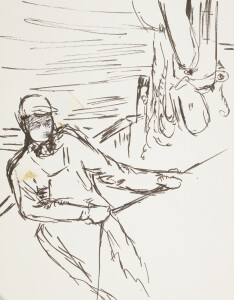 | SHORT DESCRIPTION: Drawing, pen and ink. Sketch is part of a group that documents the pound fishing in the Chesapeake Bay. This sketch is the seventh in the series and documents "Aboard the pound boat, man operates a dip net, bringing fish to the hold of the pound boat." NOTES: 1982.25.01 to 1982.25.31 illustrate the activities related to pound fishing in the Chesapeake Bay region. There is a document in the file that identifies each of the images and the particular activity the image documents. The text of the document states: Pound fishing. Pound nets or fish traps are fished spring and fall. An extensive herring fishery has declined during the past twenty years, partly because of offshore foreign fishing. At one time herring was a mainstay of the waterman’s winter diet, but any that is caught now goes into pet food, with a few being shipped off for pickling. Grey trout, striped bass, and blues are taken for wholesale and retail marketing. 1) The pound boat leaves its dock at dawn, timed for low tide at the nets. (1982.25.1); 2) Nets are hung on pine poles 25 to 70 feet long, and sway with wind, waves, and weight of the net. (1982.25.2); 3) Crewmen leave the pound boat in their skill to enter pound, a square at the end of a long leader extending shoreward. (1982.25.3); 4) Beginning to pull the seine. (1982.25.4); 5) Seine is pulled into a tight pocket. (1982.25.5); 6) Seine is close to the pound boat which has been anchored to a stake. (1982.25.6); 7) Aboard the pound boat, man operates a dip net, bringing fish to the hold of the pound boat. (1982.25.7); 8) Net is re-set on stakes for another catch. (1982.25.8); 9) Captain Walter Biddlecomb, 9 1973, who fished several deep water pounds off the mouth of the great Wicomico River. In earlier years he was a menhaden captain. (1982.25.9); 10) The catch is brought to the fish dock at Reedville, Va. (1982.25.10); 11) Sorting food and bait fish. (1982.25.11); 12) A casual buyer. (1982.25.12); 13) Fish is canned immediately. This was at the Harryhogan, Va. Cannery on the Yeocomico river, 1966, now closed. (1982.25.13); Another Day, Another Boat 14) Odell Fitchett, Palmer, Virginia (1982.25.14); 15) Pound net is loosened (1982.25.15); 16) Catch is pulled close to the pound boat (1982.25.16); 17) Title missing (1982.25.17); 18) More pulling (1982.25.18); 19) Dip net raises the fish (1982.25.19); 20) Pulling the dip net aboard pound boat (1982.25.20); 21) The last fish are dipped from the pound (1982.25.21); 22) Fitchett looking at slashes made in net by bluefish (1982.25.22); 23) He points (1982.25.23); 24) Net mending (1982.25.24); 25) Net mending (1982.25.25); 26) Net mending (1982.25.26); 27) Net mending, the blues took a considerable bit of the catch this time (1982.25.27); 28) Retying the pound (1982.25 28); 29) Unloading at the dock. (1982.25.29); 30) Lunch (1982.25.30); 31) Stern of the Jenny Dare, Fitchett boat (1982.25.31); | CL13057 | |||||||
| 75 | 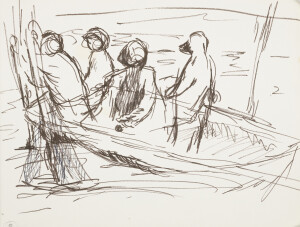 | SHORT DESCRIPTION: Drawing, pen and ink. Sketch is part of a group that documents the pound fishing in the Chesapeake Bay. This sketch is the eighth in the series and documents "Net is re-set on stakes for another catch." NOTES: 1982.25.01 to 1982.25.31 illustrate the activities related to pound fishing in the Chesapeake Bay region. There is a document in the file that identifies each of the images and the particular activity the image documents. The text of the document states: Pound fishing. Pound nets or fish traps are fished spring and fall. An extensive herring fishery has declined during the past twenty years, partly because of offshore foreign fishing. At one time herring was a mainstay of the waterman’s winter diet, but any that is caught now goes into pet food, with a few being shipped off for pickling. Grey trout, striped bass, and blues are taken for wholesale and retail marketing. 1) The pound boat leaves its dock at dawn, timed for low tide at the nets. (1982.25.1); 2) Nets are hung on pine poles 25 to 70 feet long, and sway with wind, waves, and weight of the net. (1982.25.2); 3) Crewmen leave the pound boat in their skill to enter pound, a square at the end of a long leader extending shoreward. (1982.25.3); 4) Beginning to pull the seine. (1982.25.4); 5) Seine is pulled into a tight pocket. (1982.25.5); 6) Seine is close to the pound boat which has been anchored to a stake. (1982.25.6); 7) Aboard the pound boat, man operates a dip net, bringing fish to the hold of the pound boat. (1982.25.7); 8) Net is re-set on stakes for another catch. (1982.25.8); 9) Captain Walter Biddlecomb, 9 1973, who fished several deep water pounds off the mouth of the great Wicomico River. In earlier years he was a menhaden captain. (1982.25.9); 10) The catch is brought to the fish dock at Reedville, Va. (1982.25.10); 11) Sorting food and bait fish. (1982.25.11); 12) A casual buyer. (1982.25.12); 13) Fish is canned immediately. This was at the Harryhogan, Va. Cannery on the Yeocomico river, 1966, now closed. (1982.25.13); Another Day, Another Boat 14) Odell Fitchett, Palmer, Virginia (1982.25.14); 15) Pound net is loosened (1982.25.15); 16) Catch is pulled close to the pound boat (1982.25.16); 17) Title missing (1982.25.17); 18) More pulling (1982.25.18); 19) Dip net raises the fish (1982.25.19); 20) Pulling the dip net aboard pound boat (1982.25.20); 21) The last fish are dipped from the pound (1982.25.21); 22) Fitchett looking at slashes made in net by bluefish (1982.25.22); 23) He points (1982.25.23); 24) Net mending (1982.25.24); 25) Net mending (1982.25.25); 26) Net mending (1982.25.26); 27) Net mending, the blues took a considerable bit of the catch this time (1982.25.27); 28) Retying the pound (1982.25 28); 29) Unloading at the dock. (1982.25.29); 30) Lunch (1982.25.30); 31) Stern of the Jenny Dare, Fitchett boat (1982.25.31); | CL13058 | |||||||
| 76 | 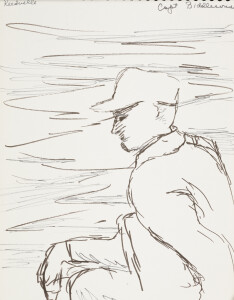 | SHORT DESCRIPTION: Drawing, pen and ink. Sketch is part of a group that documents the pound fishing in the Chesapeake Bay. This sketch is the ninth in the series and documents "Captain Walter Biddlecomb, 9 1973, who fished several deep water pounds off the mouth of the great Wicomico River. In earlier years he was a menhaden captain." NOTES: 1982.25.01 to 1982.25.31 illustrate the activities related to pound fishing in the Chesapeake Bay region. There is a document in the file that identifies each of the images and the particular activity the image documents. The text of the document states: Pound fishing. Pound nets or fish traps are fished spring and fall. An extensive herring fishery has declined during the past twenty years, partly because of offshore foreign fishing. At one time herring was a mainstay of the waterman’s winter diet, but any that is caught now goes into pet food, with a few being shipped off for pickling. Grey trout, striped bass, and blues are taken for wholesale and retail marketing. 1) The pound boat leaves its dock at dawn, timed for low tide at the nets. (1982.25.1); 2) Nets are hung on pine poles 25 to 70 feet long, and sway with wind, waves, and weight of the net. (1982.25.2); 3) Crewmen leave the pound boat in their skill to enter pound, a square at the end of a long leader extending shoreward. (1982.25.3); 4) Beginning to pull the seine. (1982.25.4); 5) Seine is pulled into a tight pocket. (1982.25.5); 6) Seine is close to the pound boat which has been anchored to a stake. (1982.25.6); 7) Aboard the pound boat, man operates a dip net, bringing fish to the hold of the pound boat. (1982.25.7); 8) Net is re-set on stakes for another catch. (1982.25.8); 9) Captain Walter Biddlecomb, 9 1973, who fished several deep water pounds off the mouth of the great Wicomico River. In earlier years he was a menhaden captain. (1982.25.9); 10) The catch is brought to the fish dock at Reedville, Va. (1982.25.10); 11) Sorting food and bait fish. (1982.25.11); 12) A casual buyer. (1982.25.12); 13) Fish is canned immediately. This was at the Harryhogan, Va. Cannery on the Yeocomico river, 1966, now closed. (1982.25.13); Another Day, Another Boat 14) Odell Fitchett, Palmer, Virginia (1982.25.14); 15) Pound net is loosened (1982.25.15); 16) Catch is pulled close to the pound boat (1982.25.16); 17) Title missing (1982.25.17); 18) More pulling (1982.25.18); 19) Dip net raises the fish (1982.25.19); 20) Pulling the dip net aboard pound boat (1982.25.20); 21) The last fish are dipped from the pound (1982.25.21); 22) Fitchett looking at slashes made in net by bluefish (1982.25.22); 23) He points (1982.25.23); 24) Net mending (1982.25.24); 25) Net mending (1982.25.25); 26) Net mending (1982.25.26); 27) Net mending, the blues took a considerable bit of the catch this time (1982.25.27); 28) Retying the pound (1982.25 28); 29) Unloading at the dock. (1982.25.29); 30) Lunch (1982.25.30); 31) Stern of the Jenny Dare, Fitchett boat (1982.25.31); | CL13059 | |||||||
| 77 |  | SHORT DESCRIPTION: Drawing, pencil, pen and ink with crayon. Sketch is part of a group that documents the pound fishing in the Chesapeake Bay. This sketch is the fourteenth in the series and documents "Odell Fitchett, Palmer, Virginia." NOTES: 1982.25.01 to 1982.25.31 illustrate the activities related to pound fishing in the Chesapeake Bay region. There is a document in the file that identifies each of the images and the particular activity the image documents. The text of the document states: Pound fishing. Pound nets or fish traps are fished spring and fall. An extensive herring fishery has declined during the past twenty years, partly because of offshore foreign fishing. At one time herring was a mainstay of the waterman’s winter diet, but any that is caught now goes into pet food, with a few being shipped off for pickling. Grey trout, striped bass, and blues are taken for wholesale and retail marketing. 1) The pound boat leaves its dock at dawn, timed for low tide at the nets. (1982.25.1); 2) Nets are hung on pine poles 25 to 70 feet long, and sway with wind, waves, and weight of the net. (1982.25.2); 3) Crewmen leave the pound boat in their skill to enter pound, a square at the end of a long leader extending shoreward. (1982.25.3); 4) Beginning to pull the seine. (1982.25.4); 5) Seine is pulled into a tight pocket. (1982.25.5); 6) Seine is close to the pound boat which has been anchored to a stake. (1982.25.6); 7) Aboard the pound boat, man operates a dip net, bringing fish to the hold of the pound boat. (1982.25.7); 8) Net is re-set on stakes for another catch. (1982.25.8); 9) Captain Walter Biddlecomb, 9 1973, who fished several deep water pounds off the mouth of the great Wicomico River. In earlier years he was a menhaden captain. (1982.25.9); 10) The catch is brought to the fish dock at Reedville, Va. (1982.25.10); 11) Sorting food and bait fish. (1982.25.11); 12) A casual buyer. (1982.25.12); 13) Fish is canned immediately. This was at the Harryhogan, Va. Cannery on the Yeocomico river, 1966, now closed. (1982.25.13); Another Day, Another Boat 14) Odell Fitchett, Palmer, Virginia (1982.25.14); 15) Pound net is loosened (1982.25.15); 16) Catch is pulled close to the pound boat (1982.25.16); 17) Title missing (1982.25.17); 18) More pulling (1982.25.18); 19) Dip net raises the fish (1982.25.19); 20) Pulling the dip net aboard pound boat (1982.25.20); 21) The last fish are dipped from the pound (1982.25.21); 22) Fitchett looking at slashes made in net by bluefish (1982.25.22); 23) He points (1982.25.23); 24) Net mending (1982.25.24); 25) Net mending (1982.25.25); 26) Net mending (1982.25.26); 27) Net mending, the blues took a considerable bit of the catch this time (1982.25.27); 28) Retying the pound (1982.25 28); 29) Unloading at the dock. (1982.25.29); 30) Lunch (1982.25.30); 31) Stern of the Jenny Dare, Fitchett boat (1982.25.31); | CL13064 | |||||||
| 78 | 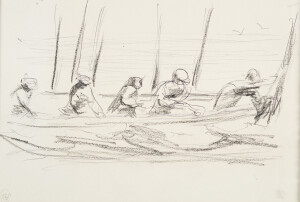 | SHORT DESCRIPTION: Drawing, pencil and crayon. Sketch is part of a group that documents the pound fishing in the Chesapeake Bay. This sketch is the fifteenth in the series and documents "Pound net is loosened." NOTES: 1982.25.01 to 1982.25.31 illustrate the activities related to pound fishing in the Chesapeake Bay region. There is a document in the file that identifies each of the images and the particular activity the image documents. The text of the document states: Pound fishing. Pound nets or fish traps are fished spring and fall. An extensive herring fishery has declined during the past twenty years, partly because of offshore foreign fishing. At one time herring was a mainstay of the waterman’s winter diet, but any that is caught now goes into pet food, with a few being shipped off for pickling. Grey trout, striped bass, and blues are taken for wholesale and retail marketing. 1) The pound boat leaves its dock at dawn, timed for low tide at the nets. (1982.25.1); 2) Nets are hung on pine poles 25 to 70 feet long, and sway with wind, waves, and weight of the net. (1982.25.2); 3) Crewmen leave the pound boat in their skill to enter pound, a square at the end of a long leader extending shoreward. (1982.25.3); 4) Beginning to pull the seine. (1982.25.4); 5) Seine is pulled into a tight pocket. (1982.25.5); 6) Seine is close to the pound boat which has been anchored to a stake. (1982.25.6); 7) Aboard the pound boat, man operates a dip net, bringing fish to the hold of the pound boat. (1982.25.7); 8) Net is re-set on stakes for another catch. (1982.25.8); 9) Captain Walter Biddlecomb, 9 1973, who fished several deep water pounds off the mouth of the great Wicomico River. In earlier years he was a menhaden captain. (1982.25.9); 10) The catch is brought to the fish dock at Reedville, Va. (1982.25.10); 11) Sorting food and bait fish. (1982.25.11); 12) A casual buyer. (1982.25.12); 13) Fish is canned immediately. This was at the Harryhogan, Va. Cannery on the Yeocomico river, 1966, now closed. (1982.25.13); Another Day, Another Boat 14) Odell Fitchett, Palmer, Virginia (1982.25.14); 15) Pound net is loosened (1982.25.15); 16) Catch is pulled close to the pound boat (1982.25.16); 17) Title missing (1982.25.17); 18) More pulling (1982.25.18); 19) Dip net raises the fish (1982.25.19); 20) Pulling the dip net aboard pound boat (1982.25.20); 21) The last fish are dipped from the pound (1982.25.21); 22) Fitchett looking at slashes made in net by bluefish (1982.25.22); 23) He points (1982.25.23); 24) Net mending (1982.25.24); 25) Net mending (1982.25.25); 26) Net mending (1982.25.26); 27) Net mending, the blues took a considerable bit of the catch this time (1982.25.27); 28) Retying the pound (1982.25 28); 29) Unloading at the dock. (1982.25.29); 30) Lunch (1982.25.30); 31) Stern of the Jenny Dare, Fitchett boat (1982.25.31); | CL13065 | |||||||
| 79 | 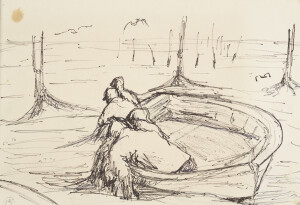 | SHORT DESCRIPTION: Drawing, pen and ink. Sketch is part of a group that documents the pound fishing in the Chesapeake Bay. This sketch is the sixteenth in the series and documents "Catch is pulled close to the pound boat ." NOTES: 1982.25.01 to 1982.25.31 illustrate the activities related to pound fishing in the Chesapeake Bay region. There is a document in the file that identifies each of the images and the particular activity the image documents. The text of the document states: Pound fishing. Pound nets or fish traps are fished spring and fall. An extensive herring fishery has declined during the past twenty years, partly because of offshore foreign fishing. At one time herring was a mainstay of the waterman’s winter diet, but any that is caught now goes into pet food, with a few being shipped off for pickling. Grey trout, striped bass, and blues are taken for wholesale and retail marketing. 1) The pound boat leaves its dock at dawn, timed for low tide at the nets. (1982.25.1); 2) Nets are hung on pine poles 25 to 70 feet long, and sway with wind, waves, and weight of the net. (1982.25.2); 3) Crewmen leave the pound boat in their skill to enter pound, a square at the end of a long leader extending shoreward. (1982.25.3); 4) Beginning to pull the seine. (1982.25.4); 5) Seine is pulled into a tight pocket. (1982.25.5); 6) Seine is close to the pound boat which has been anchored to a stake. (1982.25.6); 7) Aboard the pound boat, man operates a dip net, bringing fish to the hold of the pound boat. (1982.25.7); 8) Net is re-set on stakes for another catch. (1982.25.8); 9) Captain Walter Biddlecomb, 9 1973, who fished several deep water pounds off the mouth of the great Wicomico River. In earlier years he was a menhaden captain. (1982.25.9); 10) The catch is brought to the fish dock at Reedville, Va. (1982.25.10); 11) Sorting food and bait fish. (1982.25.11); 12) A casual buyer. (1982.25.12); 13) Fish is canned immediately. This was at the Harryhogan, Va. Cannery on the Yeocomico river, 1966, now closed. (1982.25.13); Another Day, Another Boat 14) Odell Fitchett, Palmer, Virginia (1982.25.14); 15) Pound net is loosened (1982.25.15); 16) Catch is pulled close to the pound boat (1982.25.16); 17) Title missing (1982.25.17); 18) More pulling (1982.25.18); 19) Dip net raises the fish (1982.25.19); 20) Pulling the dip net aboard pound boat (1982.25.20); 21) The last fish are dipped from the pound (1982.25.21); 22) Fitchett looking at slashes made in net by bluefish (1982.25.22); 23) He points (1982.25.23); 24) Net mending (1982.25.24); 25) Net mending (1982.25.25); 26) Net mending (1982.25.26); 27) Net mending, the blues took a considerable bit of the catch this time (1982.25.27); 28) Retying the pound (1982.25 28); 29) Unloading at the dock. (1982.25.29); 30) Lunch (1982.25.30); 31) Stern of the Jenny Dare, Fitchett boat (1982.25.31); | CL13066 | |||||||
| 80 | 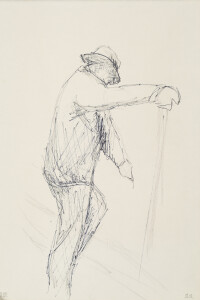 | SHORT DESCRIPTION: Drawing, pencil, pen and ink. Sketch is part of a group that documents the pound fishing in the Chesapeake Bay. This sketch is the twenty-third in the series and documents "He points." NOTES: 1982.25.01 to 1982.25.31 illustrate the activities related to pound fishing in the Chesapeake Bay region. There is a document in the file that identifies each of the images and the particular activity the image documents. The text of the document states: Pound fishing. Pound nets or fish traps are fished spring and fall. An extensive herring fishery has declined during the past twenty years, partly because of offshore foreign fishing. At one time herring was a mainstay of the waterman’s winter diet, but any that is caught now goes into pet food, with a few being shipped off for pickling. Grey trout, striped bass, and blues are taken for wholesale and retail marketing. 1) The pound boat leaves its dock at dawn, timed for low tide at the nets. (1982.25.1); 2) Nets are hung on pine poles 25 to 70 feet long, and sway with wind, waves, and weight of the net. (1982.25.2); 3) Crewmen leave the pound boat in their skill to enter pound, a square at the end of a long leader extending shoreward. (1982.25.3); 4) Beginning to pull the seine. (1982.25.4); 5) Seine is pulled into a tight pocket. (1982.25.5); 6) Seine is close to the pound boat which has been anchored to a stake. (1982.25.6); 7) Aboard the pound boat, man operates a dip net, bringing fish to the hold of the pound boat. (1982.25.7); 8) Net is re-set on stakes for another catch. (1982.25.8); 9) Captain Walter Biddlecomb, 9 1973, who fished several deep water pounds off the mouth of the great Wicomico River. In earlier years he was a menhaden captain. (1982.25.9); 10) The catch is brought to the fish dock at Reedville, Va. (1982.25.10); 11) Sorting food and bait fish. (1982.25.11); 12) A casual buyer. (1982.25.12); 13) Fish is canned immediately. This was at the Harryhogan, Va. Cannery on the Yeocomico river, 1966, now closed. (1982.25.13); Another Day, Another Boat 14) Odell Fitchett, Palmer, Virginia (1982.25.14); 15) Pound net is loosened (1982.25.15); 16) Catch is pulled close to the pound boat (1982.25.16); 17) Title missing (1982.25.17); 18) More pulling (1982.25.18); 19) Dip net raises the fish (1982.25.19); 20) Pulling the dip net aboard pound boat (1982.25.20); 21) The last fish are dipped from the pound (1982.25.21); 22) Fitchett looking at slashes made in net by bluefish (1982.25.22); 23) He points (1982.25.23); 24) Net mending (1982.25.24); 25) Net mending (1982.25.25); 26) Net mending (1982.25.26); 27) Net mending, the blues took a considerable bit of the catch this time (1982.25.27); 28) Retying the pound (1982.25 28); 29) Unloading at the dock. (1982.25.29); 30) Lunch (1982.25.30); 31) Stern of the Jenny Dare, Fitchett boat (1982.25.31); | CL13047 | |||||||
| 81 | 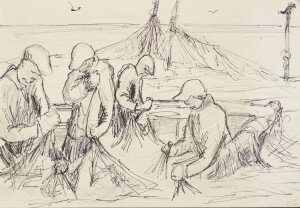 | SHORT DESCRIPTION: Drawing, pencil, pen and ink. Sketch is part of a group that documents the pound fishing in the Chesapeake Bay. This sketch is the twenty-seventh in the series and documents "Net mending, the blues took a considerable bit of the catch this time." NOTES: 1982.25.01 to 1982.25.31 illustrate the activities related to pound fishing in the Chesapeake Bay region. There is a document in the file that identifies each of the images and the particular activity the image documents. The text of the document states: Pound fishing. Pound nets or fish traps are fished spring and fall. An extensive herring fishery has declined during the past twenty years, partly because of offshore foreign fishing. At one time herring was a mainstay of the waterman’s winter diet, but any that is caught now goes into pet food, with a few being shipped off for pickling. Grey trout, striped bass, and blues are taken for wholesale and retail marketing. 1) The pound boat leaves its dock at dawn, timed for low tide at the nets. (1982.25.1); 2) Nets are hung on pine poles 25 to 70 feet long, and sway with wind, waves, and weight of the net. (1982.25.2); 3) Crewmen leave the pound boat in their skill to enter pound, a square at the end of a long leader extending shoreward. (1982.25.3); 4) Beginning to pull the seine. (1982.25.4); 5) Seine is pulled into a tight pocket. (1982.25.5); 6) Seine is close to the pound boat which has been anchored to a stake. (1982.25.6); 7) Aboard the pound boat, man operates a dip net, bringing fish to the hold of the pound boat. (1982.25.7); 8) Net is re-set on stakes for another catch. (1982.25.8); 9) Captain Walter Biddlecomb, 9 1973, who fished several deep water pounds off the mouth of the great Wicomico River. In earlier years he was a menhaden captain. (1982.25.9); 10) The catch is brought to the fish dock at Reedville, Va. (1982.25.10); 11) Sorting food and bait fish. (1982.25.11); 12) A casual buyer. (1982.25.12); 13) Fish is canned immediately. This was at the Harryhogan, Va. Cannery on the Yeocomico river, 1966, now closed. (1982.25.13); Another Day, Another Boat 14) Odell Fitchett, Palmer, Virginia (1982.25.14); 15) Pound net is loosened (1982.25.15); 16) Catch is pulled close to the pound boat (1982.25.16); 17) Title missing (1982.25.17); 18) More pulling (1982.25.18); 19) Dip net raises the fish (1982.25.19); 20) Pulling the dip net aboard pound boat (1982.25.20); 21) The last fish are dipped from the pound (1982.25.21); 22) Fitchett looking at slashes made in net by bluefish (1982.25.22); 23) He points (1982.25.23); 24) Net mending (1982.25.24); 25) Net mending (1982.25.25); 26) Net mending (1982.25.26); 27) Net mending, the blues took a considerable bit of the catch this time (1982.25.27); 28) Retying the pound (1982.25 28); 29) Unloading at the dock. (1982.25.29); 30) Lunch (1982.25.30); 31) Stern of the Jenny Dare, Fitchett boat (1982.25.31); | CL13051 | |||||||
| 82 | 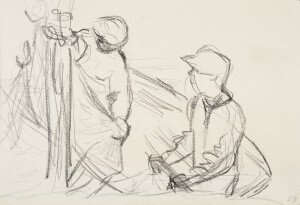 | SHORT DESCRIPTION: Drawing, pencil. Sketch is part of a group that documents the pound fishing in the Chesapeake Bay. This sketch is the twenty-eighth in the series and documents "Retying the pound ." NOTES: 1982.25.01 to 1982.25.31 illustrate the activities related to pound fishing in the Chesapeake Bay region. There is a document in the file that identifies each of the images and the particular activity the image documents. The text of the document states: Pound fishing. Pound nets or fish traps are fished spring and fall. An extensive herring fishery has declined during the past twenty years, partly because of offshore foreign fishing. At one time herring was a mainstay of the waterman’s winter diet, but any that is caught now goes into pet food, with a few being shipped off for pickling. Grey trout, striped bass, and blues are taken for wholesale and retail marketing. 1) The pound boat leaves its dock at dawn, timed for low tide at the nets. (1982.25.1); 2) Nets are hung on pine poles 25 to 70 feet long, and sway with wind, waves, and weight of the net. (1982.25.2); 3) Crewmen leave the pound boat in their skill to enter pound, a square at the end of a long leader extending shoreward. (1982.25.3); 4) Beginning to pull the seine. (1982.25.4); 5) Seine is pulled into a tight pocket. (1982.25.5); 6) Seine is close to the pound boat which has been anchored to a stake. (1982.25.6); 7) Aboard the pound boat, man operates a dip net, bringing fish to the hold of the pound boat. (1982.25.7); 8) Net is re-set on stakes for another catch. (1982.25.8); 9) Captain Walter Biddlecomb, 9 1973, who fished several deep water pounds off the mouth of the great Wicomico River. In earlier years he was a menhaden captain. (1982.25.9); 10) The catch is brought to the fish dock at Reedville, Va. (1982.25.10); 11) Sorting food and bait fish. (1982.25.11); 12) A casual buyer. (1982.25.12); 13) Fish is canned immediately. This was at the Harryhogan, Va. Cannery on the Yeocomico river, 1966, now closed. (1982.25.13); Another Day, Another Boat 14) Odell Fitchett, Palmer, Virginia (1982.25.14); 15) Pound net is loosened (1982.25.15); 16) Catch is pulled close to the pound boat (1982.25.16); 17) Title missing (1982.25.17); 18) More pulling (1982.25.18); 19) Dip net raises the fish (1982.25.19); 20) Pulling the dip net aboard pound boat (1982.25.20); 21) The last fish are dipped from the pound (1982.25.21); 22) Fitchett looking at slashes made in net by bluefish (1982.25.22); 23) He points (1982.25.23); 24) Net mending (1982.25.24); 25) Net mending (1982.25.25); 26) Net mending (1982.25.26); 27) Net mending, the blues took a considerable bit of the catch this time (1982.25.27); 28) Retying the pound (1982.25 28); 29) Unloading at the dock. (1982.25.29); 30) Lunch (1982.25.30); 31) Stern of the Jenny Dare, Fitchett boat (1982.25.31); | CL13052 | |||||||
| 83 | 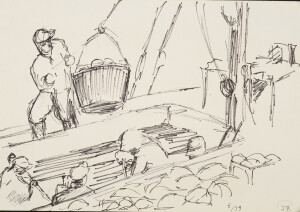 | SHORT DESCRIPTION: Drawing, pencil, pen and ink. Sketch is part of a group that documents the pound fishing in the Chesapeake Bay. This sketch is the twenty-ninth in the series and documents "Unloading at the dock." NOTES: 1982.25.01 to 1982.25.31 illustrate the activities related to pound fishing in the Chesapeake Bay region. There is a document in the file that identifies each of the images and the particular activity the image documents. The text of the document states: Pound fishing. Pound nets or fish traps are fished spring and fall. An extensive herring fishery has declined during the past twenty years, partly because of offshore foreign fishing. At one time herring was a mainstay of the waterman’s winter diet, but any that is caught now goes into pet food, with a few being shipped off for pickling. Grey trout, striped bass, and blues are taken for wholesale and retail marketing. 1) The pound boat leaves its dock at dawn, timed for low tide at the nets. (1982.25.1); 2) Nets are hung on pine poles 25 to 70 feet long, and sway with wind, waves, and weight of the net. (1982.25.2); 3) Crewmen leave the pound boat in their skill to enter pound, a square at the end of a long leader extending shoreward. (1982.25.3); 4) Beginning to pull the seine. (1982.25.4); 5) Seine is pulled into a tight pocket. (1982.25.5); 6) Seine is close to the pound boat which has been anchored to a stake. (1982.25.6); 7) Aboard the pound boat, man operates a dip net, bringing fish to the hold of the pound boat. (1982.25.7); 8) Net is re-set on stakes for another catch. (1982.25.8); 9) Captain Walter Biddlecomb, 9 1973, who fished several deep water pounds off the mouth of the great Wicomico River. In earlier years he was a menhaden captain. (1982.25.9); 10) The catch is brought to the fish dock at Reedville, Va. (1982.25.10); 11) Sorting food and bait fish. (1982.25.11); 12) A casual buyer. (1982.25.12); 13) Fish is canned immediately. This was at the Harryhogan, Va. Cannery on the Yeocomico river, 1966, now closed. (1982.25.13); Another Day, Another Boat 14) Odell Fitchett, Palmer, Virginia (1982.25.14); 15) Pound net is loosened (1982.25.15); 16) Catch is pulled close to the pound boat (1982.25.16); 17) Title missing (1982.25.17); 18) More pulling (1982.25.18); 19) Dip net raises the fish (1982.25.19); 20) Pulling the dip net aboard pound boat (1982.25.20); 21) The last fish are dipped from the pound (1982.25.21); 22) Fitchett looking at slashes made in net by bluefish (1982.25.22); 23) He points (1982.25.23); 24) Net mending (1982.25.24); 25) Net mending (1982.25.25); 26) Net mending (1982.25.26); 27) Net mending, the blues took a considerable bit of the catch this time (1982.25.27); 28) Retying the pound (1982.25 28); 29) Unloading at the dock. (1982.25.29); 30) Lunch (1982.25.30); 31) Stern of the Jenny Dare, Fitchett boat (1982.25.31); | CL13053 | |||||||
| 84 | 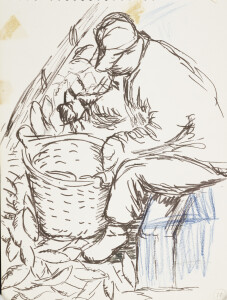 | SHORT DESCRIPTION: Drawing, pen and ink with crayon. Sketch is part of a group that documents the pound fishing in the Chesapeake Bay. This sketch is the eleventh in the series and documents "Sorting food and bait fish." NOTES: 1982.25.01 to 1982.25.31 illustrate the activities related to pound fishing in the Chesapeake Bay region. There is a document in the file that identifies each of the images and the particular activity the image documents. The text of the document states: Pound fishing. Pound nets or fish traps are fished spring and fall. An extensive herring fishery has declined during the past twenty years, partly because of offshore foreign fishing. At one time herring was a mainstay of the waterman’s winter diet, but any that is caught now goes into pet food, with a few being shipped off for pickling. Grey trout, striped bass, and blues are taken for wholesale and retail marketing. 1) The pound boat leaves its dock at dawn, timed for low tide at the nets. (1982.25.1); 2) Nets are hung on pine poles 25 to 70 feet long, and sway with wind, waves, and weight of the net. (1982.25.2); 3) Crewmen leave the pound boat in their skill to enter pound, a square at the end of a long leader extending shoreward. (1982.25.3); 4) Beginning to pull the seine. (1982.25.4); 5) Seine is pulled into a tight pocket. (1982.25.5); 6) Seine is close to the pound boat which has been anchored to a stake. (1982.25.6); 7) Aboard the pound boat, man operates a dip net, bringing fish to the hold of the pound boat. (1982.25.7); 8) Net is re-set on stakes for another catch. (1982.25.8); 9) Captain Walter Biddlecomb, 9 1973, who fished several deep water pounds off the mouth of the great Wicomico River. In earlier years he was a menhaden captain. (1982.25.9); 10) The catch is brought to the fish dock at Reedville, Va. (1982.25.10); 11) Sorting food and bait fish. (1982.25.11); 12) A casual buyer. (1982.25.12); 13) Fish is canned immediately. This was at the Harryhogan, Va. Cannery on the Yeocomico river, 1966, now closed. (1982.25.13); Another Day, Another Boat 14) Odell Fitchett, Palmer, Virginia (1982.25.14); 15) Pound net is loosened (1982.25.15); 16) Catch is pulled close to the pound boat (1982.25.16); 17) Title missing (1982.25.17); 18) More pulling (1982.25.18); 19) Dip net raises the fish (1982.25.19); 20) Pulling the dip net aboard pound boat (1982.25.20); 21) The last fish are dipped from the pound (1982.25.21); 22) Fitchett looking at slashes made in net by bluefish (1982.25.22); 23) He points (1982.25.23); 24) Net mending (1982.25.24); 25) Net mending (1982.25.25); 26) Net mending (1982.25.26); 27) Net mending, the blues took a considerable bit of the catch this time (1982.25.27); 28) Retying the pound (1982.25 28); 29) Unloading at the dock. (1982.25.29); 30) Lunch (1982.25.30); 31) Stern of the Jenny Dare, Fitchett boat (1982.25.31); | CL13061 | |||||||
| 85 | 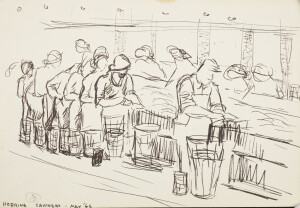 | SHORT DESCRIPTION: Drawing, pen and ink. Sketch is part of a group that documents the pound fishing in the Chesapeake Bay. This sketch is the thirteenth in the series and documents "Fish is canned immediately. This was at the Harryhogan, Va. Cannery on the Yeocomico river, 1966, now closed.." NOTES: 1982.25.01 to 1982.25.31 illustrate the activities related to pound fishing in the Chesapeake Bay region. There is a document in the file that identifies each of the images and the particular activity the image documents. The text of the document states: Pound fishing. Pound nets or fish traps are fished spring and fall. An extensive herring fishery has declined during the past twenty years, partly because of offshore foreign fishing. At one time herring was a mainstay of the waterman’s winter diet, but any that is caught now goes into pet food, with a few being shipped off for pickling. Grey trout, striped bass, and blues are taken for wholesale and retail marketing. 1) The pound boat leaves its dock at dawn, timed for low tide at the nets. (1982.25.1); 2) Nets are hung on pine poles 25 to 70 feet long, and sway with wind, waves, and weight of the net. (1982.25.2); 3) Crewmen leave the pound boat in their skill to enter pound, a square at the end of a long leader extending shoreward. (1982.25.3); 4) Beginning to pull the seine. (1982.25.4); 5) Seine is pulled into a tight pocket. (1982.25.5); 6) Seine is close to the pound boat which has been anchored to a stake. (1982.25.6); 7) Aboard the pound boat, man operates a dip net, bringing fish to the hold of the pound boat. (1982.25.7); 8) Net is re-set on stakes for another catch. (1982.25.8); 9) Captain Walter Biddlecomb, 9 1973, who fished several deep water pounds off the mouth of the great Wicomico River. In earlier years he was a menhaden captain. (1982.25.9); 10) The catch is brought to the fish dock at Reedville, Va. (1982.25.10); 11) Sorting food and bait fish. (1982.25.11); 12) A casual buyer. (1982.25.12); 13) Fish is canned immediately. This was at the Harryhogan, Va. Cannery on the Yeocomico river, 1966, now closed. (1982.25.13); Another Day, Another Boat 14) Odell Fitchett, Palmer, Virginia (1982.25.14); 15) Pound net is loosened (1982.25.15); 16) Catch is pulled close to the pound boat (1982.25.16); 17) Title missing (1982.25.17); 18) More pulling (1982.25.18); 19) Dip net raises the fish (1982.25.19); 20) Pulling the dip net aboard pound boat (1982.25.20); 21) The last fish are dipped from the pound (1982.25.21); 22) Fitchett looking at slashes made in net by bluefish (1982.25.22); 23) He points (1982.25.23); 24) Net mending (1982.25.24); 25) Net mending (1982.25.25); 26) Net mending (1982.25.26); 27) Net mending, the blues took a considerable bit of the catch this time (1982.25.27); 28) Retying the pound (1982.25 28); 29) Unloading at the dock. (1982.25.29); 30) Lunch (1982.25.30); 31) Stern of the Jenny Dare, Fitchett boat (1982.25.31); | CL13063 | |||||||
| 86 | 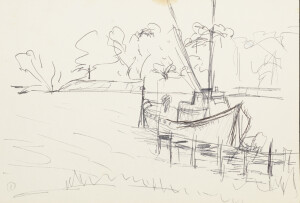 | SHORT DESCRIPTION: Drawing, pen and ink with pencil. Sketch is part of a group that documents the pound fishing in the Chesapeake Bay. This sketch is the first in the series and documents "The pound boat leaves its dock at dawn, timed for low tide at the nets." NOTES: 1982.25.01 to 1982.25.31 illustrate the activities related to pound fishing in the Chesapeake Bay region. There is a document in the file that identifies each of the images and the particular activity the image documents. The text of the document states: Pound fishing. Pound nets or fish traps are fished spring and fall. An extensive herring fishery has declined during the past twenty years, partly because of offshore foreign fishing. At one time herring was a mainstay of the waterman’s winter diet, but any that is caught now goes into pet food, with a few being shipped off for pickling. Grey trout, striped bass, and blues are taken for wholesale and retail marketing. 1) The pound boat leaves its dock at dawn, timed for low tide at the nets. (1982.25.1); 2) Nets are hung on pine poles 25 to 70 feet long, and sway with wind, waves, and weight of the net. (1982.25.2); 3) Crewmen leave the pound boat in their skill to enter pound, a square at the end of a long leader extending shoreward. (1982.25.3); 4) Beginning to pull the seine. (1982.25.4); 5) Seine is pulled into a tight pocket. (1982.25.5); 6) Seine is close to the pound boat which has been anchored to a stake. (1982.25.6); 7) Aboard the pound boat, man operates a dip net, bringing fish to the hold of the pound boat. (1982.25.7); 8) Net is re-set on stakes for another catch. (1982.25.8); 9) Captain Walter Biddlecomb, 9 1973, who fished several deep water pounds off the mouth of the great Wicomico River. In earlier years he was a menhaden captain. (1982.25.9); 10) The catch is brought to the fish dock at Reedville, Va. (1982.25.10); 11) Sorting food and bait fish. (1982.25.11); 12) A casual buyer. (1982.25.12); 13) Fish is canned immediately. This was at the Harryhogan, Va. Cannery on the Yeocomico river, 1966, now closed. (1982.25.13); Another Day, Another Boat 14) Odell Fitchett, Palmer, Virginia (1982.25.14); 15) Pound net is loosened (1982.25.15); 16) Catch is pulled close to the pound boat (1982.25.16); 17) Title missing (1982.25.17); 18) More pulling (1982.25.18); 19) Dip net raises the fish (1982.25.19); 20) Pulling the dip net aboard pound boat (1982.25.20); 21) The last fish are dipped from the pound (1982.25.21); 22) Fitchett looking at slashes made in net by bluefish (1982.25.22); 23) He points (1982.25.23); 24) Net mending (1982.25.24); 25) Net mending (1982.25.25); 26) Net mending (1982.25.26); 27) Net mending, the blues took a considerable bit of the catch this time (1982.25.27); 28) Retying the pound (1982.25 28); 29) Unloading at the dock. (1982.25.29); 30) Lunch (1982.25.30); 31) Stern of the Jenny Dare, Fitchett boat (1982.25.31); | CL13075 | |||||||
| 87 |    | Circa 1960-1970 | Calvert Cliffs Nuclear Power Plant (Md.)–Photographs.; North Carolina Maritime Museum–Photographs.; Reedville Oil & Guano Co. Photographs.; Standard Products Company, Inc. Photographs.; Pacific Biological Station (1908-1955)–Photographs. | Chesapeake Bay (Md. and Va.)–Photographs.; Chesapeake Bay Region (Md. and Va.)–Photographs.; Portugal–Photographs.; Sardinia (Italy)–Photographs.; Hagios Nikolaos (Lasithi, Greece)–Photographs.; Vancouver (B.C.)–Photographs.; Victoria (B.C.)–Photographs.; Mobjack Bay (Va.)–Photographs.; Iceland–Photographs.; Chesapeake Bay Bridge-Tunnel (Va.)–Photographs.; Rappahannock River (Va.)–Photographs.; Yeocomico River (Va.)–Photographs.; Tangier Island (Va.)–Photographs.; Potomac River–Photographs.; Poplar Island (Talbot County, Md.)–Photographs. | Rivers–Chesapeake Bay Region (Md. and Va.)–Photographs.; Fishing boats–Chesapeake Bay Region (Md. and Va.)–Photographs.; Work boats–Chesapeake Bay Region (Md. and Va.)–Photographs.; Fishing boats–Iceland–Photographs.; Fishing boat industry–Iceland–Photographs.; Marinas–Chesapeake Bay Region (Md. and Va.)–Photographs.; Marine railways–Chesapeake Bay Region (Md. and Va.)–Photographs.; Herring industry–Chesapeake Bay Region (Md. and Va.)–Photographs.; Menhaden industry–Chesapeake Bay Region (Md. and Va.)–Photographs.; Yachts–Chesapeake Bay Region (Md. and Va.)–Photographs.; Pound net fishing–Chesapeake Bay Region (Md. and Va.)–Photographs.; Fishers–Chesapeake Bay Region (Md. and Va.)–Photographs.; Human beings–Chesapeake Bay Region (Md. and Va.)–Photographs.; Historic sites–Chesapeake Bay Region (Md. and Va.)–Photographs.; Monuments–Chesapeake Bay Region (Md. and Va.)–Photographs. | Contains photographic negatives of Reedville Oil and Guano Company, Windmill Point boat show, Iceland and Icelandic fishing boats, Christchurch School Marine Institute, Piraeus Port near Athens, Greece, Piraeus Yacht Basin, the yacht "Turkia", Agios Nikolaos, Crete, mussel farms in Sardinia, Italy, cliff fishing in Portugal, Nanaimo Biological Station in Vancouver, British Columbia, fish docks in Vancouver, the boat "Ocean Tide", Victoria, British Columbia, shrimp boats, pelicans and other seabirds, Tangier Island parks marina, tide mill in Mobjack Bay, Rappahannock River Yacht Club, Wachapreague marina, Rice's marine railway, Old Orchard Pond, Munday Point, Yeocomico river, workboats, fishing boats, East river, Sunnybank Ferry and Fish Dock, Sunnybank fish market, Cape Charles fish dock, Berry's fish dock, Bellows house, Humphreys house, menhaden, herring, Civil War monument in Heathsville, Virginia, Reed monument in Reedville, Virginia, Reedville homes, Fleeton homes, Beaufort (North Carolina) Maritime Museum, Cockrell's Creek, Merry Point Ferry, Poplar Island, Maryland, Chesapeake Bay Bridge Tunnel fishing pier, Meyer waterfront, Old Orchard Point, Oxford Harbor, Rice Inn, Calvert Cliffs, Calvert Cliffs Nuclear Power Plant, pound fishing, Captain Larry Reese, the fishing boat "Lilly Mae", Standard Products, Odell Fitchett, fishermen, Rappahannock river, Windmill Point, pound stakes, the setting-up of pound stakes, raising of pound nets, pound boats, pound net preparation, Potomac river, Thomas F. Tubb, and Herbert Sisson. | MS0199/02-14 | |||
| 88 | 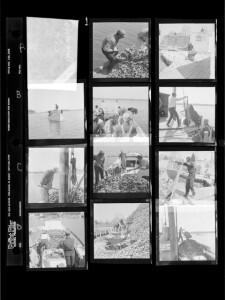 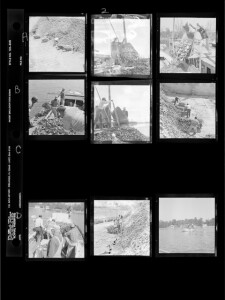 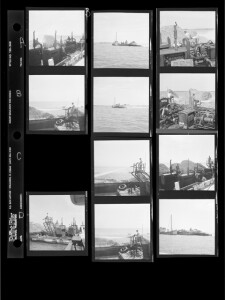 | 1960-1979 | Virginia Institute of Marine Science–Photographs.; Royal Vancouver Yacht Club–Photographs.; Potomac River Fisheries Commission–Photographs.; Virginia. Commission of Fisheries–Photographs.; Standard Products Company, Inc. Photographs.; Reedville Oil & Guano Co. Photographs.; Calvert Cliffs Nuclear Power Plant (Md.)–Photographs. | Chesapeake Bay (Md. and Va.)–Photographs.; Chesapeake Bay Region (Md. and Va.)–Photographs.; Piraeus (Greece)–Photographs.; Cape Canaveral (Fla.)–Photographs.; Great Wicomico River (Va.)–Photographs.; Potomac River–Photographs.; Rappahannock River (Va.)–Photographs.; Piankatank River (Va.)–Photographs.; Tangier Island (Va.)–Photographs.; Chesapeake Bay Bridge-Tunnel (Va.)–Photographs.; Smith Island (Md. and Va.)–Photographs. | Oyster industry–Chesapeake Bay Region (Md. and Va.)–Photographs.; Oyster fisheries–Chesapeake Bay Region (Md. and Va.)–Photographs.; Fishing boats–Chesapeake Bay Region (Md. and Va.)–Photographs.; Sailboats–Chesapeake Bay Region (Md. and Va.)–Photographs.; Work boats–Chesapeake Bay Region (Md. and Va.)–Photographs.; Yachts–Chesapeake Bay Region (Md. and Va.)–Photographs.; Marine railways–Chesapeake Bay Region (Md. and Va.)–Photographs.; Fishers–Chesapeake Bay Region (Md. and Va.)–Photographs.; Boaters (Persons)–Chesapeake Bay (Md. and Va.)–Photographs.; Yacht racing–Chesapeake Bay Region (Md. and Va.)–Photographs.; Pound net fishing–Chesapeake Bay Region (Md. and Va.)–Photographs.; Menhaden industry–Chesapeake Bay Region (Md. and Va.)–Photographs.; Human beings–Chesapeake Bay Region (Md. and Va.)–Photographs.; Historic sites–Chesapeake Bay Region (Md. and Va.)–Photographs.; Nuclear power plants–Chesapeake Bay Region (Md. and Va.)–Photographs.; Waterfowl–Chesapeake Bay Region (Md. and Va.)–Photographs.; Shore birds–Chesapeake Bay Region (Md. and Va.)–Photographs.; Yacht clubs–Chesapeake Bay Region (Md. and Va.)–Photographs.; Yachting–Chesapeake Bay Region (Md. and Va.)–Photographs. | Contains photographic negatives of oyster shell-planting, shucking machines, Windmill Point Hatchery, Windmill Point Oyster Company in Urbanna, Virginia, oyster shucking, seeding at the Wicomico river area, aerial shots of Swan Point, the Virginia Institute of Marine Science, tongs and shafts, oyster-shucking rigs, tongers on the Potomac river, log canoes on the Corrotoman river, Captain C. E. "Sonny" Thomas and his mate Henry Hughes of the Virginia Fisheries Commission, oyster harvesters, Elmer Coats, oyster tong shafts, Great Wicomico river, Piankatank river, Rappahannock river, boat-builders Virgil Miller and Carl V. Pederson, boatbuilding, Miller's marine railway, the boat "Jim Lee", the Urbanna Oyster Festival of 1978, fishermen, watermen, pound boats, C. E. Wilmore, J. D. Krentz, J. L. Reynolds of the Baltimore Army Engineer's Office, boat models, Krentz Marine Sport Fishery, various photographs taken for Frye's book "The Men All Singing", the founder of menhaden fishing company Standard Products H. R. Humphreys Sr., founder of menhaden fishing company at Cape Henlopen, Delaware, Sherman Curry, Smith Island, Captain Lawson Tyler, 1977 Chesapeake Bay Appreciation Day in Sandy Point, Maryland, National Marine Fisheries Association, Captain Alfred Biddlecomb, Tangier Island, the boat "Jorisuda", lighthouse models, Reedville Oil and Guano Company, Windmill Point Marine Lodge, Windmill Point boat show, fishing boats, Christchurch School Marine Institute, Piraeus Port near Athens, Greece, the motorship "Turkia", English Bay in Vancouver, British Columbia, Royal Vancouver Yacht Club, yachts, the yacht "Migrant", Port Canaveral, Florida, Bellows house, Civil War memorial at Heathville Village Square, Reed monument at Reedville, Baltimore G & E Calvert Cliffs Nuclear Plant, Chesapeake Bay Bridge Tunnel, the boat "Lilly Mae", pound fishing, fish market, the boat "Jenny Dare", the boat "Albert T. Graham", net-mending, Sunnybank Fish Dock and Ferry, Icelandic fishing boats, Rappahannock River Yacht Club, boat-racing, Potomac River Fisheries Commission, the yacht "Maryland Lady", the boat "Captain Thomas", waterfowl, and shorebirds. | MS0199/02-13 | |||
| 89 | 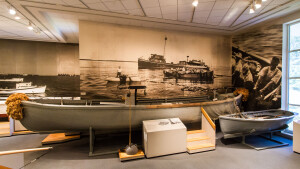 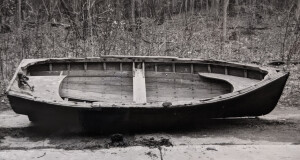 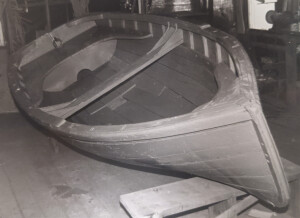 | SHORT DESCRIPTION: Grey mehaden striker boat. Round-bottom, double-hull, oak frames and knees, and cedar planking. NOTES: This was formerly BU 55. Two wooden oars with 26" tapered blades, barrel shaped hand grips, round, untapered looms were purchased from J. Cooper's on June 4, 1989. NOTES: Manned by a solitary fisherman called a "striker" or "driver," this boat would be teamed with a pair of accompanying seing boats to capture schools of mehaden in an encircling purse seine net. After directing the seine boats into position the striker, who often stood in the boat, would literally strike the water with his oars, thereby herding the fish into the net. Once the net was closed the striker rowed his boat to the side of the net opposite the seine boats. There, he would "pull the corks," that is, raise the net's floating bunt line and tie it off to numerous short ropes attached to his boat. This prevented the panicked fish from escaping over the top of the net. Like the larger seine boats, the striker boat was ruggedly built, and equipped with large ring bolts for hoisting aboard the mother ship. The introduction of spotter aircraft in the menhaden fishery after World War II reduced the need for such striker boats, and the last left service in the 1960s. NOTES: Article by Nancy Woodall: The Striker, or Driver, Boat, was an integral part of the menhaden fishing scene, in the early days of that industry. Twelve or thirteen feet in length, these boats were round-bottomed, and double-hulled for extra strength. Built with oak frames and knees, and cedar planking, they were also extremely heavy for their size. When a school of menhaden was sighted by the lookout, the striker, or driver, would be sent out in his small boat, which he rowed standing, to determine the direction the school was moving. His directions and signals guided the purse boats (seine boats) as they attempted to bring the net around the school of fish. While the net was being set, the striker would try to drive the fish into the net by striking the water with his oars. "Just before the purse boats came together to close the circle, he rowed into it to the arc opposite the boats and raised enough fish net floats on the bow of this little tender craft to keep the fish from over-riding the net as they dashed about." The weight of the loaded net might pull the boat down to her gunwales, but she was bouyant as a cork. A few striker boats continued on the job until the middle 1950s. Nowadays, however, a spotter plane has replaced the striker boat, and directions are radioed to the seine boats. When the need for these work boats ended, most were just abandoned, but a few have been rescued and restored. NOTES: Article in Northumberland Echo 7/23/1987, interview with David Scarbrough, the boatwright at Rock Hall that restored the striker boat for the Museum. "Also to be found in the boat shop of Rock Hall was a diminutive yet mighty looking workboat donated by Standard Products of Reedville [incorrect. The boat was donated by Humphrey's Railway Inc. the boat was made by Standard Products Co., Inc.]. One look at this shiny grey striker boat and the whole era of oar-powered menhaden fishing comes rushing back powerful and romantic. This boat was still used in the '50s, Scarbrough said. Not big enough for purse boat activities, it was thought that those who rode the striker directed the purse boat fleet as it cast its nets. Scarbrough said these boats were probably mass produced, and though short, the boat is wide and heavy, presenting a powerfully constructed hull with gently curving planks steamed to make them supple enough to hammer into place. A heavy keel juts from the rear of the vessel giving the boat's structure added strength and more stability. The striker was powered by oars, and though they are missing on the specimen headed for the museum, utilized tall oar locks for the extra long handles that must have been needed to move this heavy little titan across the bay. Inside, an inner deck planking was installed to strengthen the boat even more. Called the "ceiling" this deck also covered the frame of the hull and provided a better foothold for passengers. The industrial looking grey striker also needed little, but finely detailed, work to prepare it for its debut as a museum piece, though Scarbrough said it would take quite a bit more to get the boat seaworthy again. At either end the boat includes 4-inch galvanized steel rings used to lift and hold it on its mother menhaden vessel. Near the rear of the deck a cleverly crafted drain well is situated with a drain plug com plete with a wooden stopper. This device helped keep the deck dry while in the water. ADDITIONAL INFORMATION: SEE: John Frye, "The Smell of Money--A History of Virginia's Menhaden Industry" National Fisherman Yearbook, 1973. | CL6976 | |||||||
| 90 |    | 1992 | Maryland Shipbuilding & Drydock Company–Photographs.; Norfolk Shipbuilding & Drydock Co. (Va.)–Photographs. | Chesapeake Bay Region (Md. and Va.)–Photographs.; Chesapeake Bay (Md. and Va.)–Photographs.; Baltimore, Port of (Md.)–Photographs.; Coan River (Va.)–Photographs.; Rappahannock River (Va.)–Photographs.; Tangier Island (Va.)–Photographs.; Fishermans Island National Wildlife Refuge (Va.)–Photographs.; Elizabeth River (Va.)–Photographs.; Naval Operating Base (Va.). | Work boats–Chesapeake Bay Region (Md. and Va.)–Photographs.; Fishing boats–Chesapeake Bay (Md. and Va.)–Photographs.; Fishing boats–Chesapeake Bay Region (Md. and Va.)–Photographs.; Yachts–Chesapeake Bay Region (Md. and Va.)–Photographs.; Barges–Chesapeake Bay Region (Md. and Va.)–Photographs.; Canoes and canoeing–Chesapeake Bay Region (Md. and Va.)–Photographs.; Menhaden industry–Chesapeake Bay Region (Md. and Va.)–Photographs.; Grain trade–Chesapeake Bay Region (Md. and Va.)–Photographs.; Docks–Chesapeake Bay Region (Md. and Va.)–Photographs.; Marinas–Chesapeake Bay Region (Md. and Va.)–Photographs.; Harbors–Chesapeake Bay Region (Md. and Va.)–Photographs.; Marine railways–Chesapeake Bay Region (Md. and Va.)–Photographs.; Rivers–Chesapeake Bay Region (Md. and Va.)–Photographs.; Schooners–Chesapeake Bay Region (Md. and Va.)–Photographs.; Boating industry–Chesapeake Bay Region (Md. and Va.)–Photographs.; Boatbuilding–Chesapeake Bay Region (Md. and Va.)–Photographs.; Sailboats–Chesapeake Bay Region (Md. and Va.)–Photographs.; Gas industry–Chesapeake Bay Region (Md. and Va.)–Photographs. | Contains photographic negatives of the grain boat "Carol Ann", power suction tubes, unloading of cargo, Captain Arthur Eubank of "Carol Ann", Baltimore Harbor, Stephens' marine railway, Coan river, Southern States grain dock, the boat "Lillian Ruth", boat collisions at Rappahannock river, the grain ship "Magdalena Oldendorf", the boat "Eugenia", Mill Creek, Thorndike grain elevator, Norfolk Naval Base, Continental dock at Elizabeth river, grain boats, yachts, barges, fishing boats, workboats, aircraft carriers, Locust Point dock in Baltimore, the hydrokeel "Lida Lady", hover-crafts, the boat "Jim Lee", boat salvage, schooners, salvage from the schooner "Mary Hickman", Highland Landing Cove, the boat "Albert T. Graham", the ocean survey ship "Discoverer", compass adjustments, Maryland Shipbuilding & Drydock in Baltimore, the ship "Seafreeze Pacific", Miller's marine railway, the yacht "Cleapatra's Barge", NORSHIPCO Titan Drydock Operation, D. Addison Cockrell's marine railway, the excursion boat "Captain Thomas", J. D. Krentz marine railway, Tangier Island, Smith Fish Packery, the boats "Northern Eagle" and "Primavera", the boat "Carolinian", Smith Point marina, the menhaden boat "William S. Brusstar", the boat "Cape Charles", boat captain Odell Lawson, Fisherman's Island, the menhaden steamer"G. S. Alynn", the Coast Guard training vessel "Cuyahoga", the charter boat "Hiawatha", Zapata-Haynie dock, the fishing boat "Southland", Humphrey's marine railway, the boat "Raymond Humphreys", log canoes, Mathews County Yacht Club, the boat "Shell Keys", Spa Creek Harbor in Annapolis, the boat "Polly Doyle", Paul Anderton's Boat Shop in Annapolis, the sailing yacht "Anhelo", sailboats, the excursion boat "Miss Ann", the boat "Harvey Brewer", boat commissionings, Shackelford Fish Company, fiberglass boats, Hayes Boat Company, navigation instruments, Bowis marina, Adjootian's boatyard, tugboats, Columbia Liquid Natural Gas plant in Cove Point, Maryland, boat construction, and Reedville oil dock. | MS0199/02-15 | |||
| 91 | 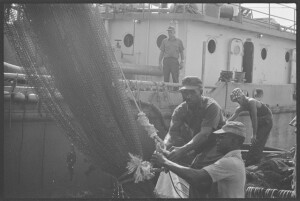 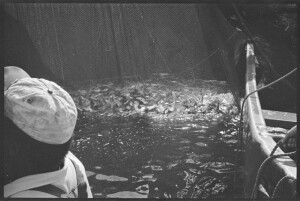 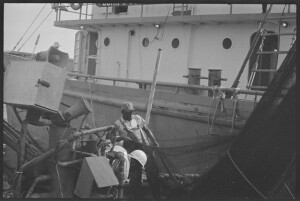 | Circa 1960-1970 | Standard Products Company, Inc. Photographs.; Seacoast Products, Inc. Photographs.; McNeal Co. Inc. Photographs. | Chesapeake Bay Region (Md. and Va.)–Photographs.; Port Monmouth (N.J.)–Photographs.; Louisiana–Photographs.; Rappahannock River (Va.)–Photographs. | Menhaden industry–Chesapeake Bay Region (Md. and Va.)–Photographs.; Menhaden industry–Louisiana–Photographs.; Menhaden industry–New Jersey–Photographs.; Fishing boats–Chesapeake Bay Region (Md. and Va.)–Photographs.; Work boats–Chesapeake Bay Region (Md. and Va.)–Photographs.; Transports–Chesapeake Bay Region (Md. and Va.)–Photographs.; Fishers–Chesapeake Bay Region (Md. and Va.)–Photographs.; Fish trade–Chesapeake Bay Region (Md. and Va.)–Photographs.; Docks–Chesapeake Bay Region (Md. and Va.)–Photographs.; Marine railways–Chesapeake Bay Region (Md. and Va.)–Photographs.; Boatbuilding–Chesapeake Bay Region (Md. and Va.)–Photographs.; Human beings–Chesapeake Bay Region (Md. and Va.)–Photographs. | Contains photographic negatives of the boat "Dempster", menhaden, the boat "John D. Diehl", Captain Leland Robinson and other fishing boat captains, fishing boats, fishermen, watermen, the ship "Atlantic Queen", Bellows' and Squire's fish factory, P.S. Green, Joseph S. Bellows, Captain Lacey Rose, Rappahannock river, purse nets and purse net repair, purse boats, Standard Products company, the boat "Lilly Mae", menhaden plant polution control, menhaden fishing, Standard Products plant, menhaden fishing fleets, Seacoast Menhaden Plant in Cameron, Louisiana, fish factory in Empire, Louisiana, Seacoast Products in Port Monmouth, New Jersey, Taft fish factory, McNeal Menhaden Plant in Fairport, Virginia, Dougle's fish factory, menhaden products and production, 2H Labs at Reedville, Virginia, trial run of the boat "Allen W. Haynie", the boat "North State", the boat "Hugh Haynie", Humphrey's marine railway, the boat "Mary S. Lewis", the boat "Ruth Conway", the boat "C. W. Curlett", the boat "Carol Ann", the ship "USS Grafton", the boat "Jim-O" at drydock, menhaden kelley boat "Marie", Cockrell's Creek, boat repair, Carter's Creek, and Captain Wallace E. Lewis. | MS0199/02-18 |
Created 2026 by Don Barker, CBMM volunteer, for the Chesapeake Shipbuilding Project. shipbuilding@sailingworkboats.es